Silicone casting 15/01/19

river project, UNIT 2, Videos, Work in Progress

This slideshow requires JavaScript.

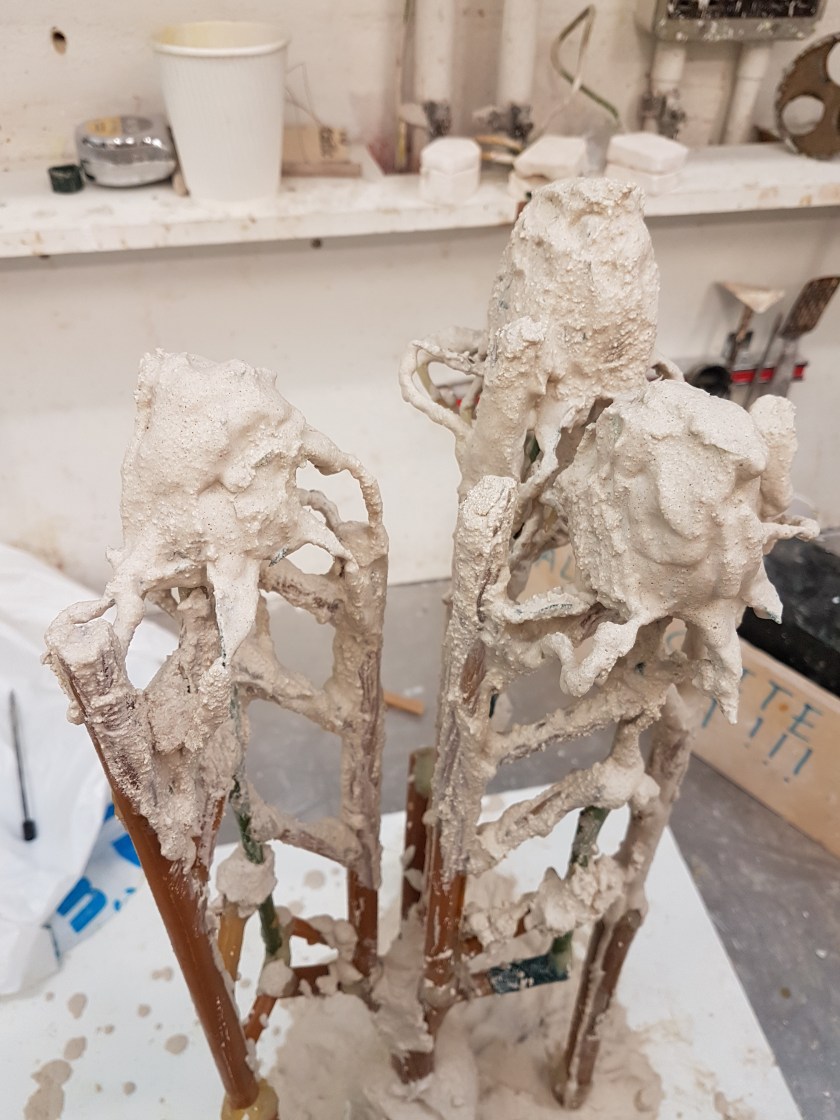
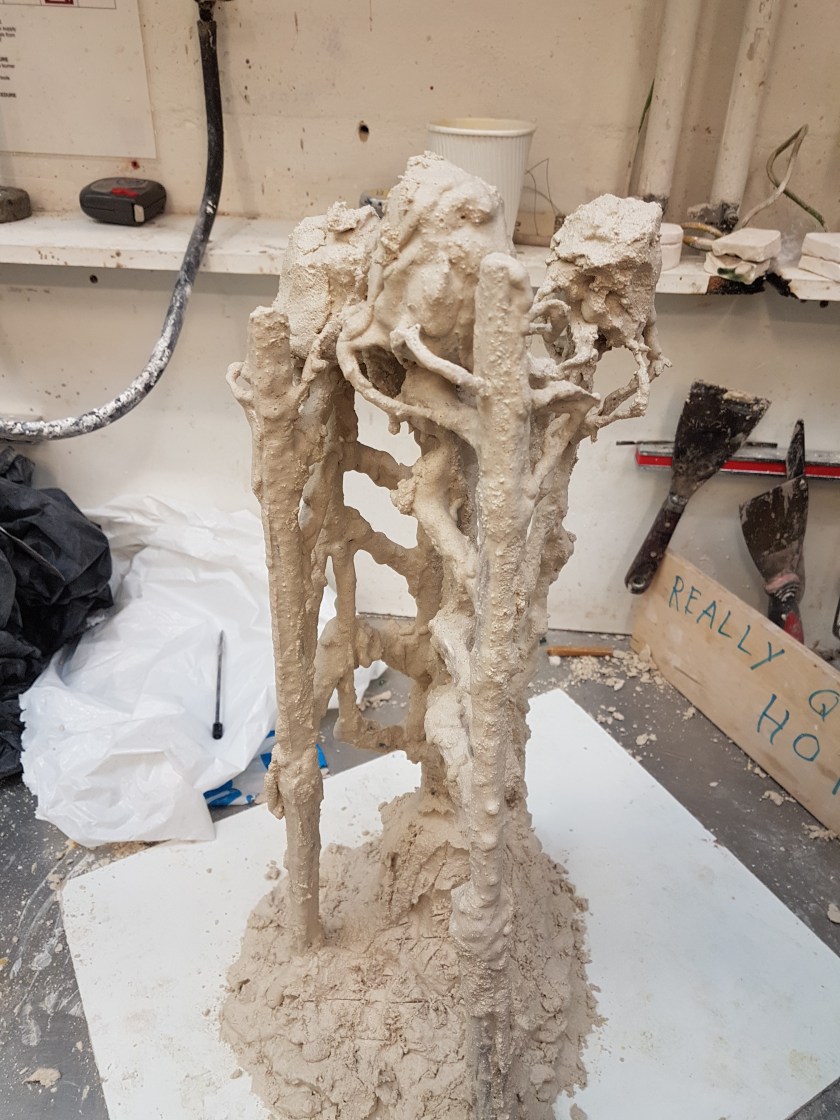
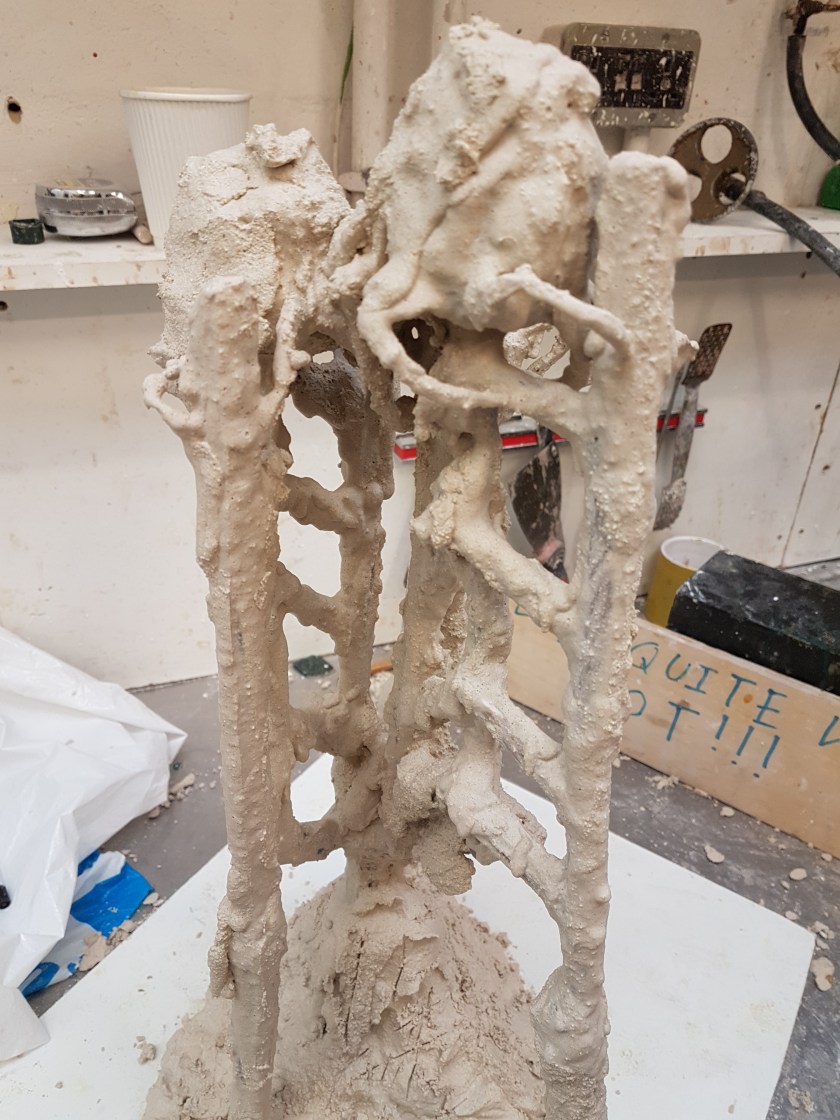
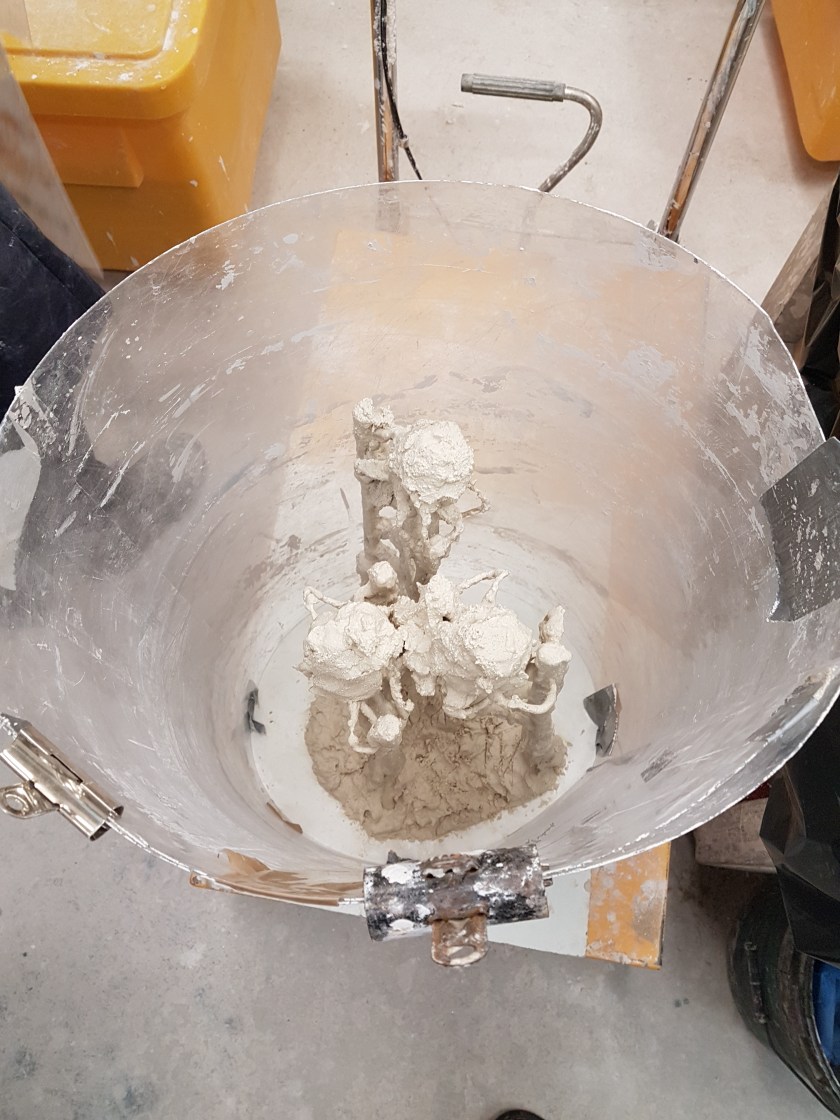
I decided to make silicone casts of the bones, to explore a different material and its potential for my project- and luckily someone else in the foundry also wanted to work with silicone too, so Lindsay mixed up the last bit of silicone she had for us both to use. Unfortunately there wasn’t enough to cast the brick or jaw pieces, so I may revisit this material once she has more in stock. The photos above show the process- weighing and mixing the two parts of the silicone, then pouring it into my moulds, the same as when I used the wax and plaster, as well as photos of the silicone bones de-moulded.

The above video shows clips of all the bones, and demonstrates the qualities of the silicone- as you can see it is a very tactile material that I have had a lot of fun playing with! There is something very surreal about squashing a pink bone in your hands, and being able to fold it then watch it spring back when you let go, and I am very happy with the results of this experiment.

When I get the chance to present these to the class the main feedback I want is whether or not to cut off the excess silicone- the bronze and aluminium casts don’t have the “feet”, but the plaster and glass wax pieces do, so this is something I need to consider when deciding what to present and how in the final exhibition.

Weekly To Do List 14/01/19

river project, UNIT 2, Weekly To Do Lists

Monday:

  • Morning – help prep sandpit and mould for the pour in the afternoon
  • 12pm- meet Adamina and experiment with 3D scanning and printing

Tuesday:

  • Morning- Glass wax cast the jaw pieces and redo the brick
  • Afternoon- start making silicone casts of bones

Wednesday:

  • I have work in the evening so I will probably rest during the day

Thursday:

  • 10am – 12pm Group tutorial
  • Continue casting in glass wax/silicone/polymer plaster (brick)
  • Work on aluminium bone casts?

Friday:

  • Photograph pieces so far
  • Continue working on presentation for 7th March

Glass Wax Tests 11/01/19

Photographs, river project, UNIT 2, Videos, Weekly Summaries, Work in Progress

This slideshow requires JavaScript.


Some photos taken of the process of casting with glass wax- the melting glass wax, the casts full of glass wax, and photos of the failed jaw bone casts and brick cast. Casting the brick hollow with glass wax is proving troublesome- the wax is very brittle and the sides of the cast keep breaking as I try to de-mould it. I will try one more time to cast it hollow but a bit thicker and if that doesn’t work I might have to cast it solid instead. The jaw bone pieces kept failing as the glass wax is too thick and not hot enough to flow all the way through the moulds- I will try to get it hotter next time, but I have to be careful in case the wax gets too hot and the colour changes.

Video demonstrating the properties of glass wax and the casting process.
I wanted to explore the properties and materiality of glass wax, and these are the results so far.
Clip 1: the chunk of unmelted glass wax, demonstrating what it looks like before it is melted and cast- you can see how the light refracts and passes through it.
Clip 2 and 3: the glass wax as it melts, showing the viscosity and how it stretches and flows much like real glass when in molten form. It is very different to other waxes I have used in the past.
Clips 4 and 5: the first attempts at casting the jaw bones in glass wax- as you can see the wax didn’t flow completely through the moulds as it was not hot enough and cooled too fast. I will try again but with the wax much hotter so hopefully it will flow through the moulds properly.
The rest of the clips: the other bone casts in glass wax.

This slideshow requires JavaScript.

These photos show the second attempt at casting the jaw bones in glass wax (still not hot enough), the glass wax casts all together, the broken hollow brick cast (the details were captured beautifully, it’s just a shame that the sides broke), and one of the glass wax casts lit by Jonathan’s phone torch- as an experiment to see how light travels through them. I think going forwards I would like to photograph the glass wax pieces with a light source beneath them like this, but using a more professional set up.

Notes on glass wax:

  • Properties- melts differently to waxes I have used in the past (i.e. the green and orange waxes used in uni, soy wax, paraffin wax, beeswax)
  • As it melts it goes quite stringy and is still very thick and viscous, can be stretched into glass-like threads that look like nylon thread
  • It sets VERY quickly and needs to be quite hot to pour well, but you have to be super careful not to overheat it as it can make the wax change colour
  • You can add oil paint as a pigment to glass wax, but I’m more interested in how it looks originally- like a translucent glass
  • I might do one or two in colour just to see what it looks like, but we’ll see
  • It is quite brittle- I tried to make a hollow brick cast and the sides shattered (like glass) as I tried to remove the cast- if I retry this I will need to make it thicker
  • It picks up detail really beautifully and I’m definitely impressed
  • I need to redo the jaw bones in glass wax as the wax wasn’t hot enough and as a result didn’t flow through the moulds properly


Weekly To Do List 07/01/19 – 11/01/19

UNIT 2, Weekly To Do Lists

Was out of action yesterday, so here is my plan for the rest of the week.

Tuesday:

  • Use glass wax to make casts using bone moulds
  • Redo herculite hollow brick cast, as first attempt broke
  • If pos- do herculite casts from the jaw silicone putty moulds today

Wednesday:

  • I have work 3.30-10pm, so I don’t expect to get anything physical done, will upload photos from Tuesday if pos

Thursday:

  • De-mould everything from Tuesday
  • Bronze pour- assist where possible for my bronze rose mould (digging the sand pit, moving the moulds into sand pit, securing moulds in sand pit)

Friday:

  • Make sure all photos are uploaded
  • Reflect on progress
  • Foundry is shut- I should use this time to research and start planning my presentation for 7th March

Weekend:

  • I have work both days so I won’t have time to do physical work, may do some research before or after work

UPDATE 10/

I Can’t Help The Way I Feel: Fat Bodies Drawing Workshop

FAT Project, Personal Projects, UNIT 2, Workshops

Do you identify as fat?

Would you like to draw and be drawn in a safe space for like minded postgraduate students who also identify as fat?
Join Kat Outten for a workshop ran by a fat Post-Grad student, for fat Post-Grad students.

Created in response to the sculpture by John Isaacs currently in the Medicine Now exhibit at the Wellcome Collection, fat is so much more than a body type. We deserve to celebrate and love our bodies as much as anyone else- to do so in this current culture is a rebellious act that defies social norms.

rtaImage.jpg

(Image above used to promote the event, a photograph of the sculpture the workshop is a response to, printed in black and white, with illustrations of fat bodies drawn over the top. Photograph and drawings by me)

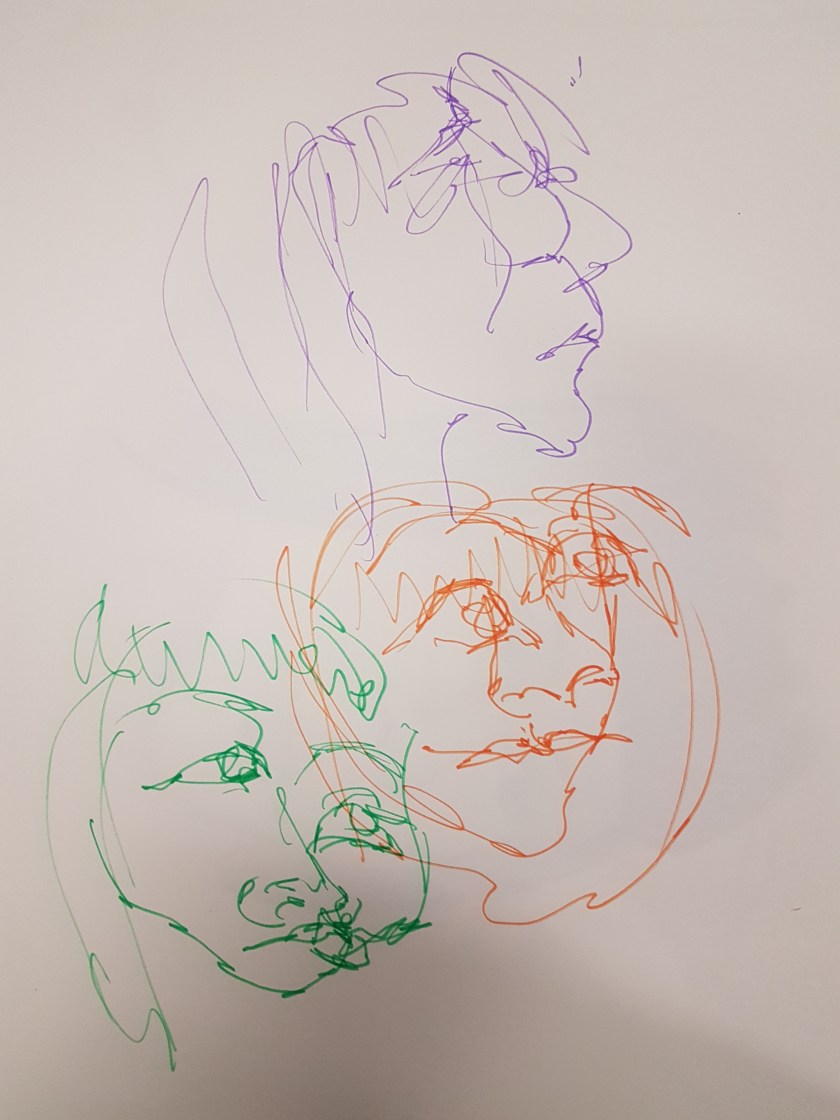
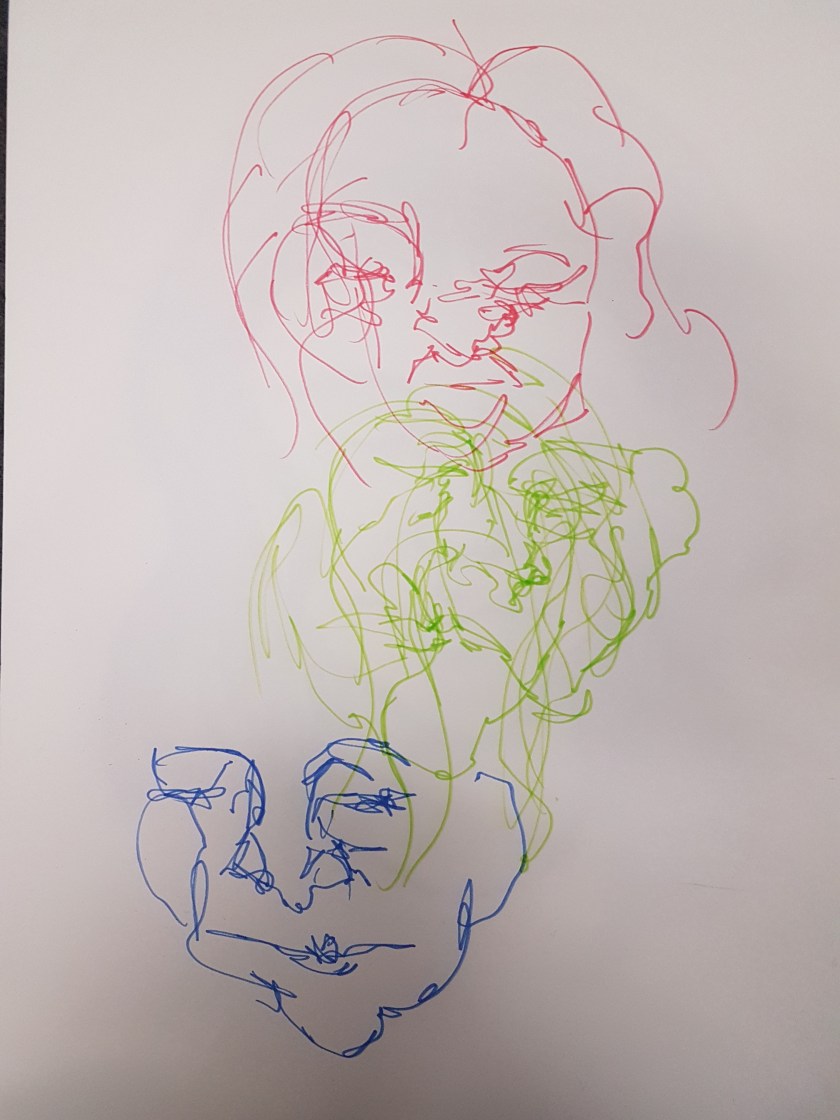
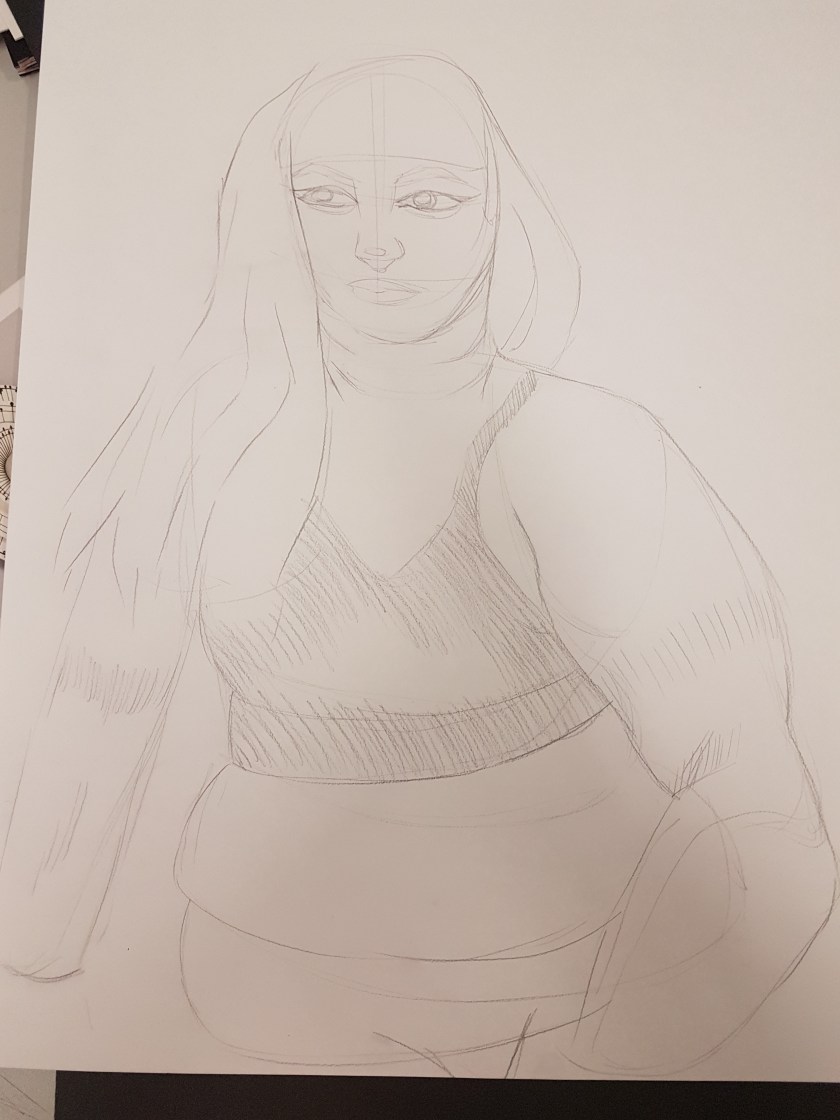
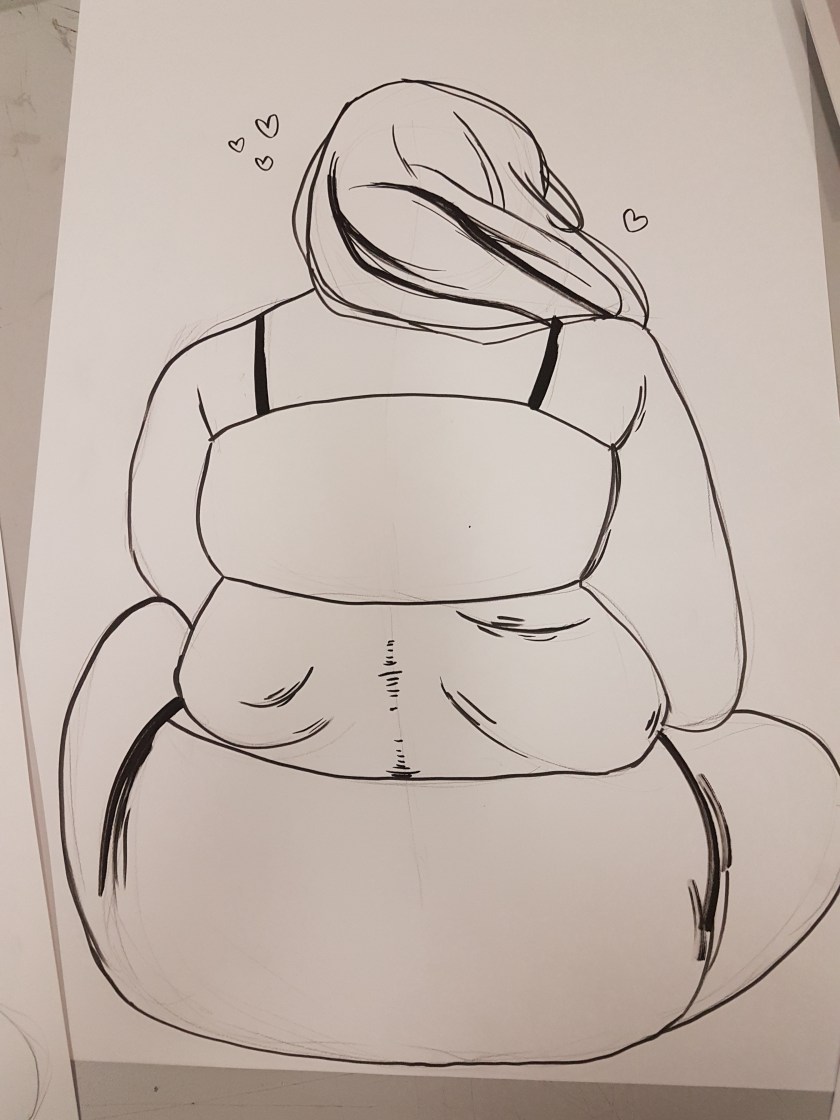
As part of my role as Post Graduate Ambassador for Camberwell I organised a drawing workshop, aimed at fat post grad students. The workshop was in response to a piece of work I find very repulsive at the Wellcome Collection, with the goal of creating a safe space for fat post grad artists to come together and celebrate our bodies. We ran the workshop on Monday 10th December at CSM for 2 and half hours, and I was very excited to meet fellow fat creatives. Unfortunately it didn’t go as I envisioned. There ended up being only two fat people in attendance- myself and my friend who is not from UAL whom I invited. The other attendees were not fat by most societal standards, and this was something that caused both myself and my friend a lot of anxiety. Where we had hoped to be in a room full of people like us, we instead felt incredibly anxious and judged.

It may not have been the intention of the other attendees, but when thin people invade safe spaces designed for fat people it leaves those who are fat feeling alien and excluded. Having to listen to someone talk about how they used to be fat, (FYI size 16 is actually the average size of a woman in the UK) how they didn’t feel welcome in some fat spaces, and about their fatter friends was actually deeply patronising and insulting, but we felt unable to voice these opinions. It made both of us deeply distressed, which was the opposite of how I hoped we would feel at the end of the workshop. It has taken me a while to write this blog post, as I have been trying to organise my thoughts and write about the workshop in a less emotional way, however I now realise that my emotions are a valid response, and I would be doing myself a disservice not to put them down.

The artwork that this workshop was a response to caused a deeply emotional and visceral response in me when I first heard about it, and even more so when I saw it in person. When you see something that is an exaggeration of what your own body looks like and you witness school children walk past it making disgusted noises and making comments like “ew that’s what happens when you eat too much”, amongst other things, it does not make you feel good. It made me feel sick, angry, upset, and brought to the surface all of the body image issues I have been struggling with since I was a child. The fact that fat bodies are objectified and ridiculed by society means that safe spaces where we can be ourselves without shame are deeply important and needed.

The vast majority of people who are not fat, and who have never been fat, cannot understand what it is like to exist in a fat body. Our bodies are constantly policed, every choice we make scrutinised; from what we “can” and “can’t” wear, what we “should” and “shouldn’t” eat, how much or little we exercise, to whether we need mobility aids, and how we travel.

When being fat is enough to have people bully and fat shame you in school, in shops, online, at work, on public transport, in court, –pretty much everywhere you go- it is a daily act of rebellion to even dare to exist.

I understand that anyone, at any size, can feel “fat” and struggle with body issues and self esteem, and I am not trying to detract from that, or invalidate their feelings. Diet culture, fatphobia, and our society’s obsession with the “perfect” body affects everyone, but those who are not what western society considers to be “fat” should be mindful of the impact their presence will have when they enter a safe space designed for fat people.

Safe spaces are not exclusionary, but by definition they should be spaces where marginalised people feel safe, comfortable, and able to express themselves- this can be difficult when people who do not share your experiences talk over you and take over the space. If you are entering a safe space that is not aimed at you (for example, if you are straight and entering a safe space for LGBTQ+ people) it is up to you to be thoughtful, considerate of your words and actions, and to listen to what members of that marginalised group have to say. Acknowledge that you come from a place of privilege, and choose to be part of a positive change. Ask questions, but respect that some things might be hard to answer.

This is not what happened at the workshop, and it was deeply saddening and frustrating. Going forwards I plan on organising this event again, outside of UAL, so that I can invite all the amazing, non UAL fat creatives I know from social media, and hopefully create the space I hoped for.

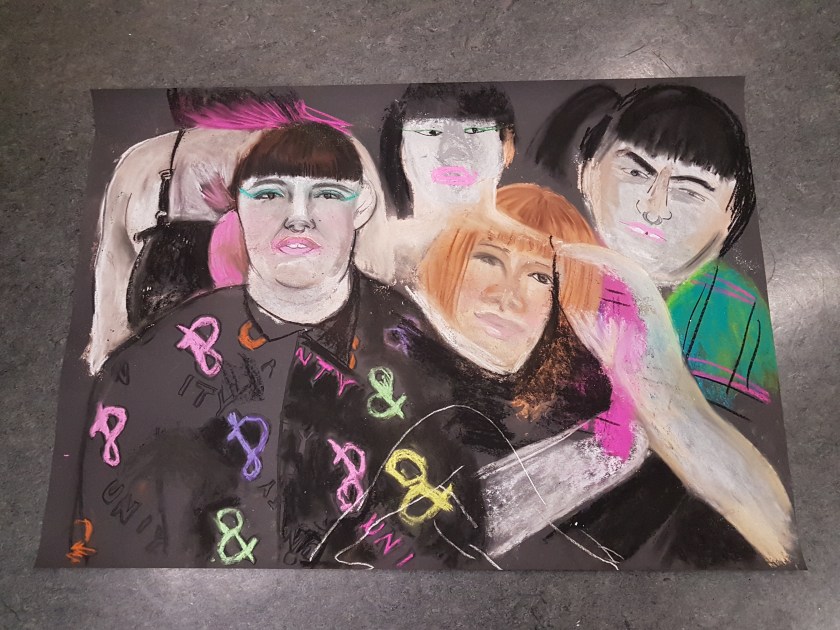
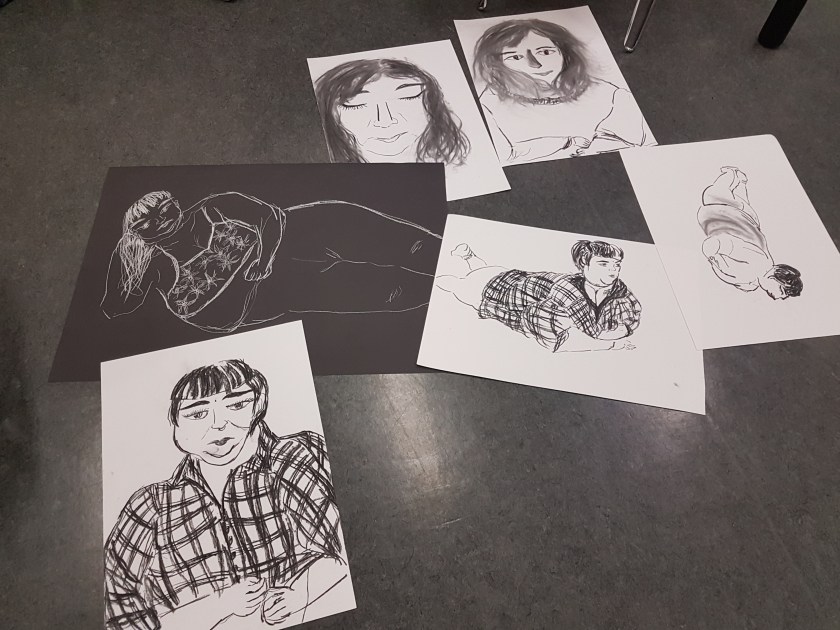
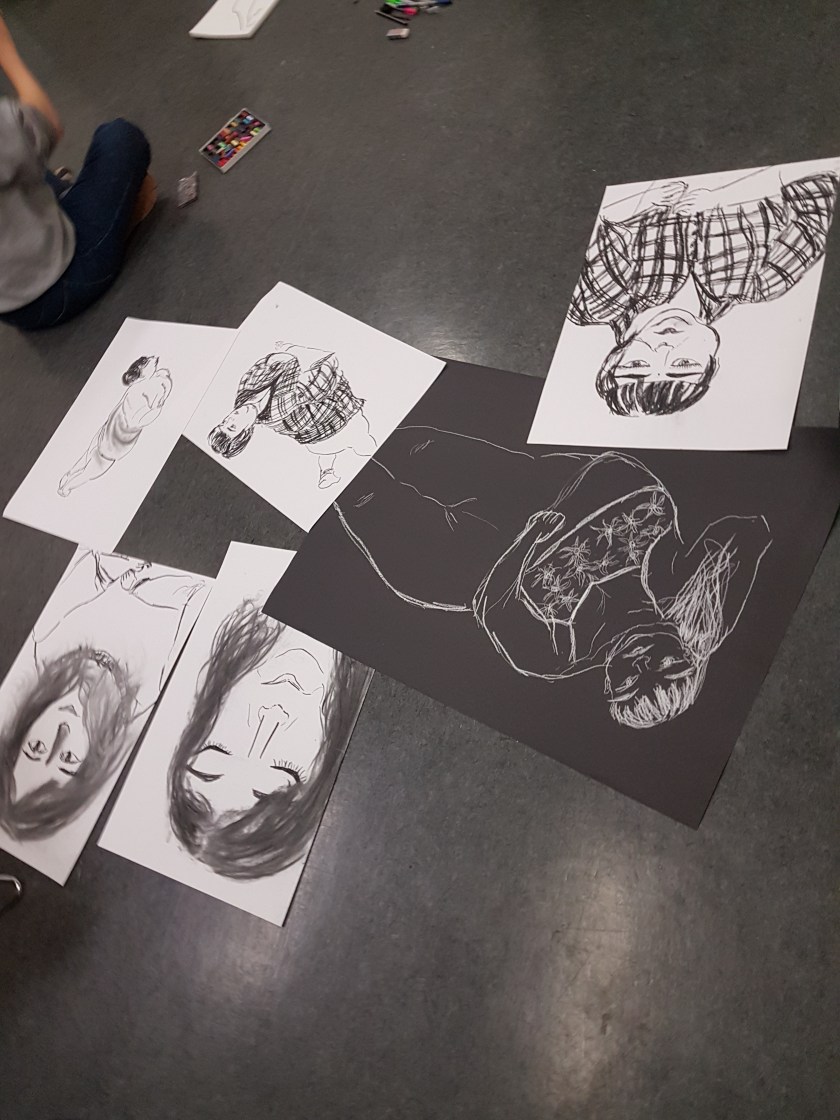
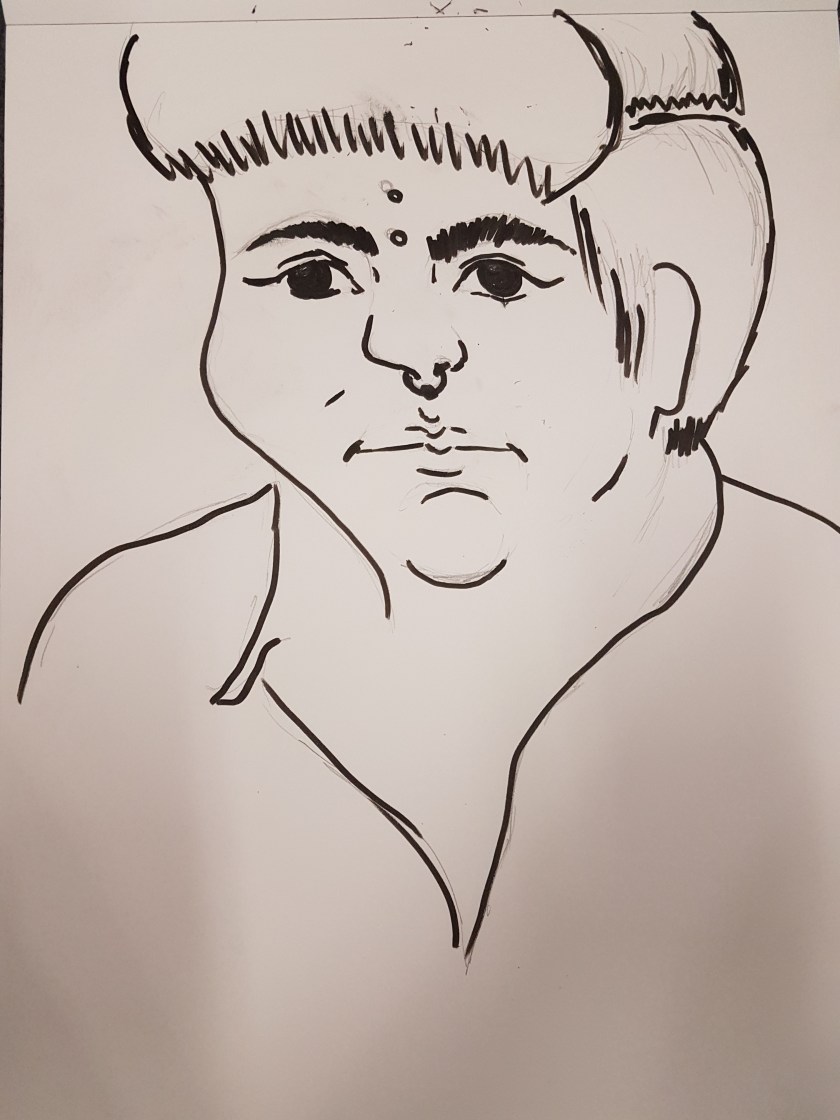
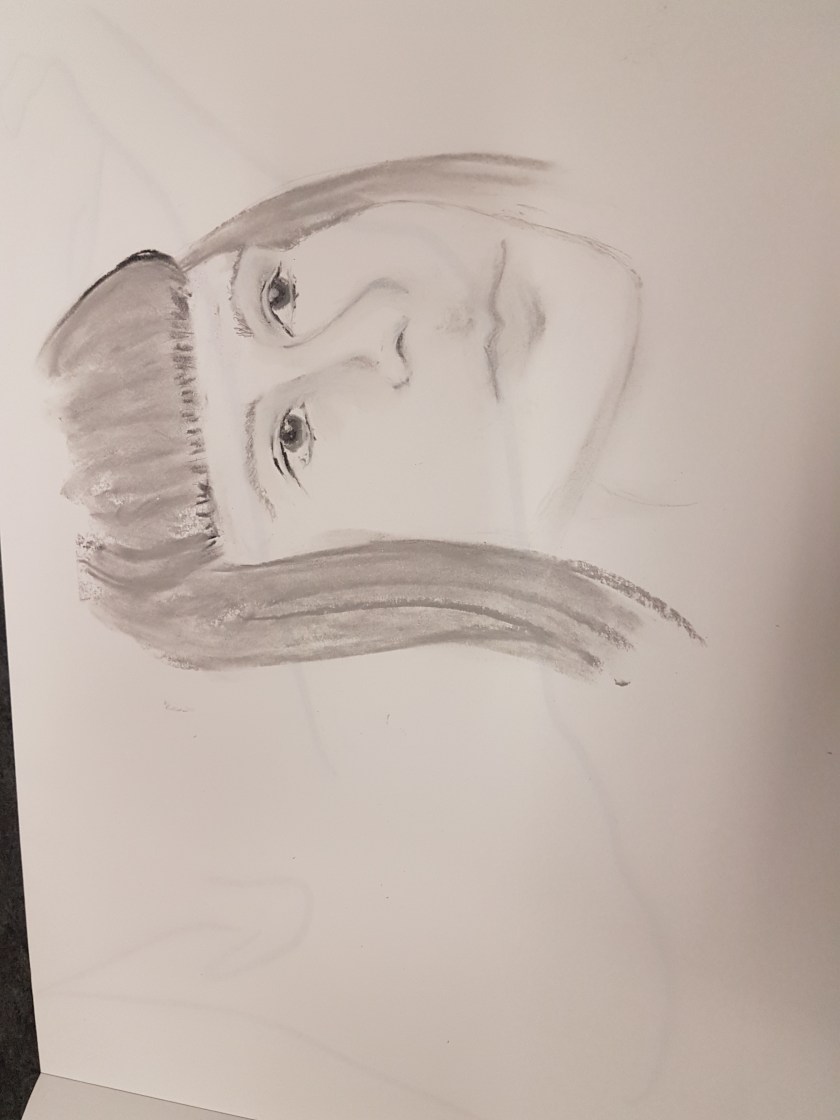
Below are photographs of some of the work created during the workshop, which came out really cool! So a positive amongst the negatives.
Vectors: 60 Years of Digital Art Practice, Dr. Nick Lambert 06/12/19

Lectures/Talks, Uncategorized
  • Art of the Electronic Age“- book
  • started back in the late 90’s researching digital art and its origins
  • Frank Popper
  • Cold war period and how types of computer developed during this period
  • CACHE Project Archive
  • Computer Art Society
  • John Lansdown
  • using computers for architecture, performance, animation, ect
  • the transference from computers being large and only used by limited people to being smaller and in the home
  • shifts in technology and culture
  • early digital media doesn’t survive very well- mostly survives on paper, due to  changes in formats and storage devices, and their fragility
  • digital dark age came about due to these changes
  • emulating old systems to archive older online/digital materials
  • is everything worth saving, if we could save everything?
  • Ideas Before Their Time, 2010
  • Brian Peffin-Smith – big in the digital art scene
  • is there a digital aesthetic? How can it be defined?
  • an interchange between you and the machine/programme
  • what is the computers most important contribution to visual arts?
  • can the computer become a creative agent in its own right?
  • inter connectivity of artists and makers via the internet
  • features and “intelligent” programming can shape and try to dictate what you are creating- you can turn it off a lot of the time, but it can still help or hinder the creator
  • the urge to fill empty spaces with imagery- colonising new spaces, such as the web
  • Frieder Nake
  • art as a commodity
  • Computer Graphics and Computer Art– Herbert Franke
  • the shift from the web being democratic and open to becoming heavily monetised and heavily marketed
  • Warhol- works for Commodore
  • why use modern technology in order to generate the most traditional formats of the art world? i.e. printing and framing digital art and putting it on the wall
  • Gilbert and George- Ginko Pictures, 2005
  • Duchamp Land” and “Turing Land
  • using digital mediums as another form of artistic expression
  • Senster– Edward Ihatowicz, 1970
  • Scriabin- Prometheus
  • is the digital a tool or a medium?
  • Visual media Lumia


Plaster Room 03/12/18

Weekly Summaries, Work in Progress

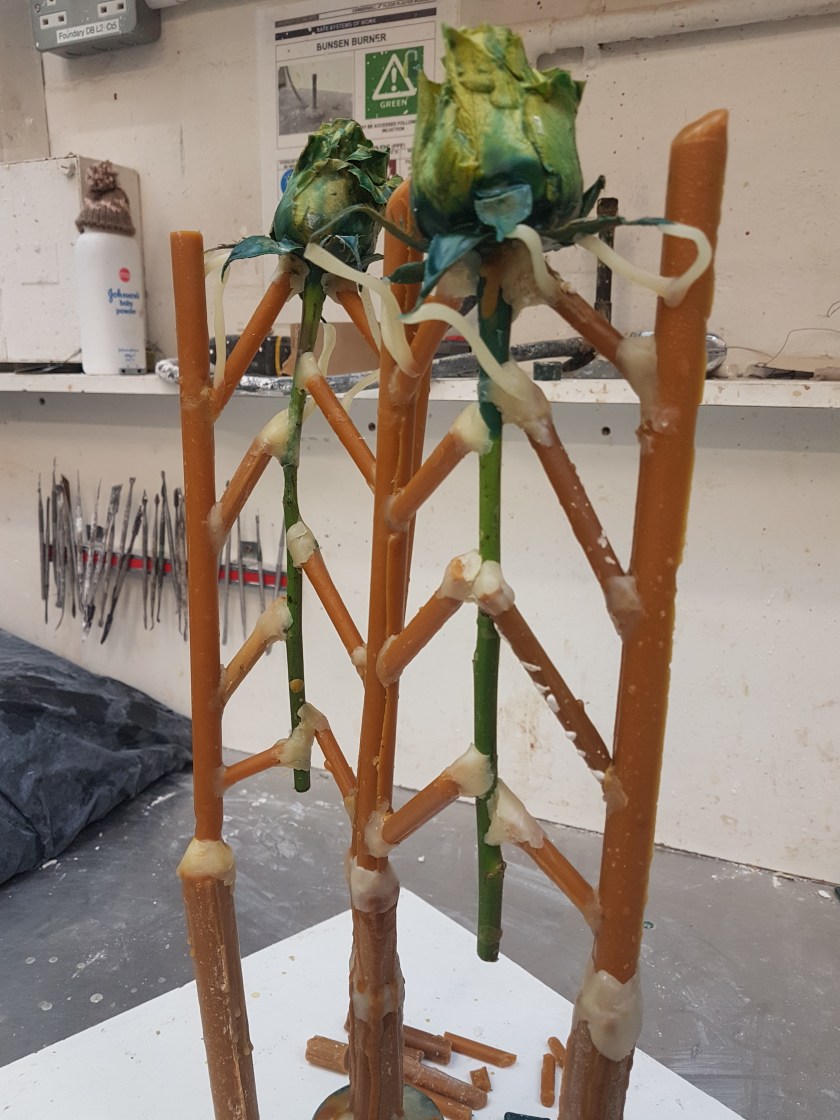
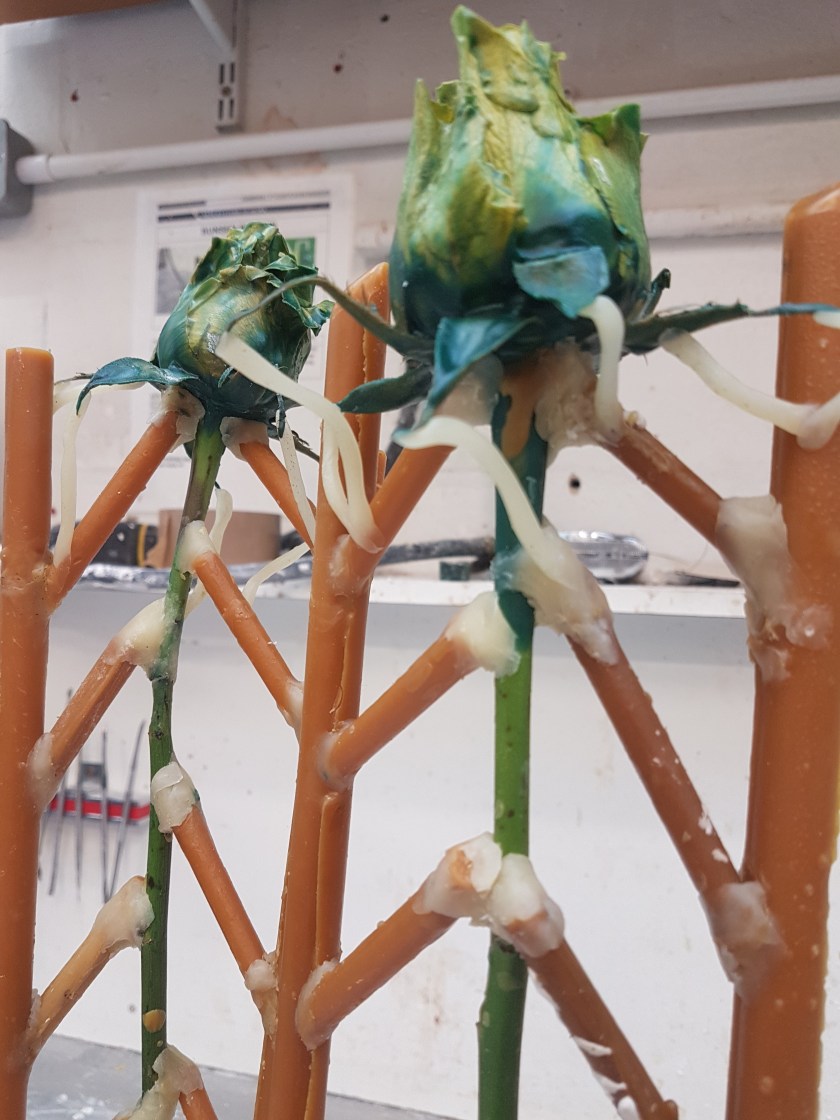
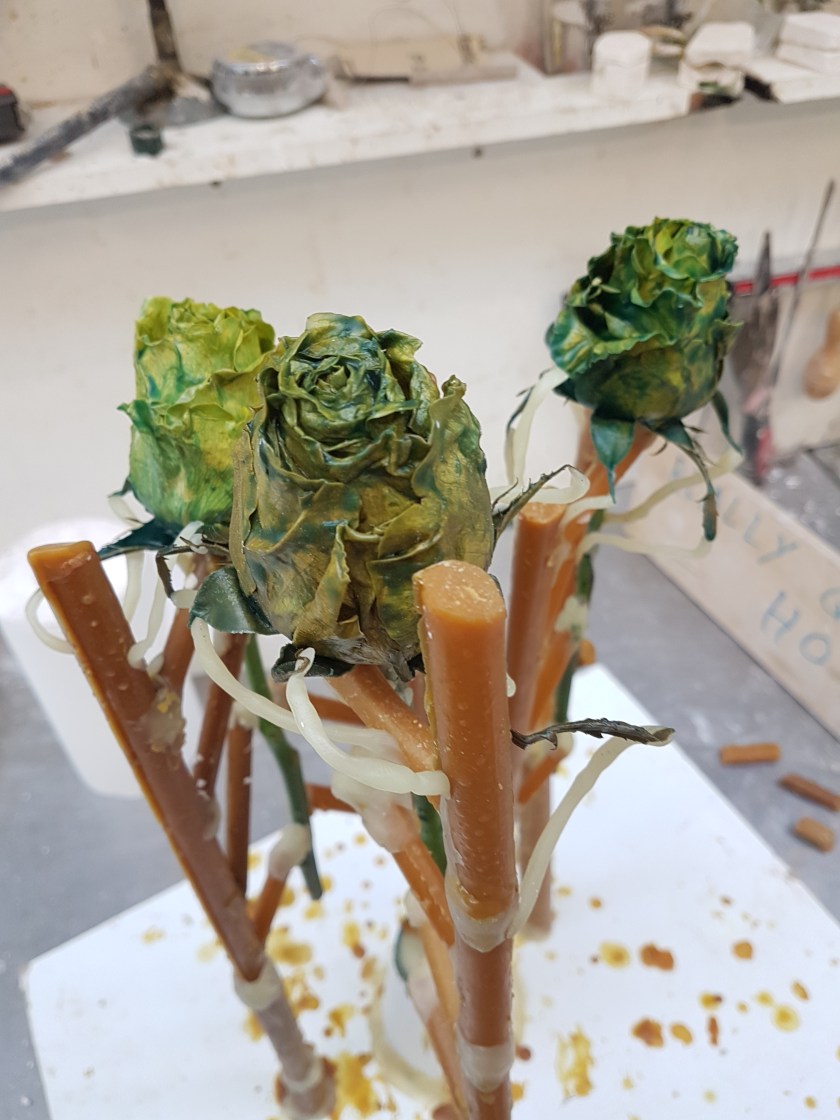
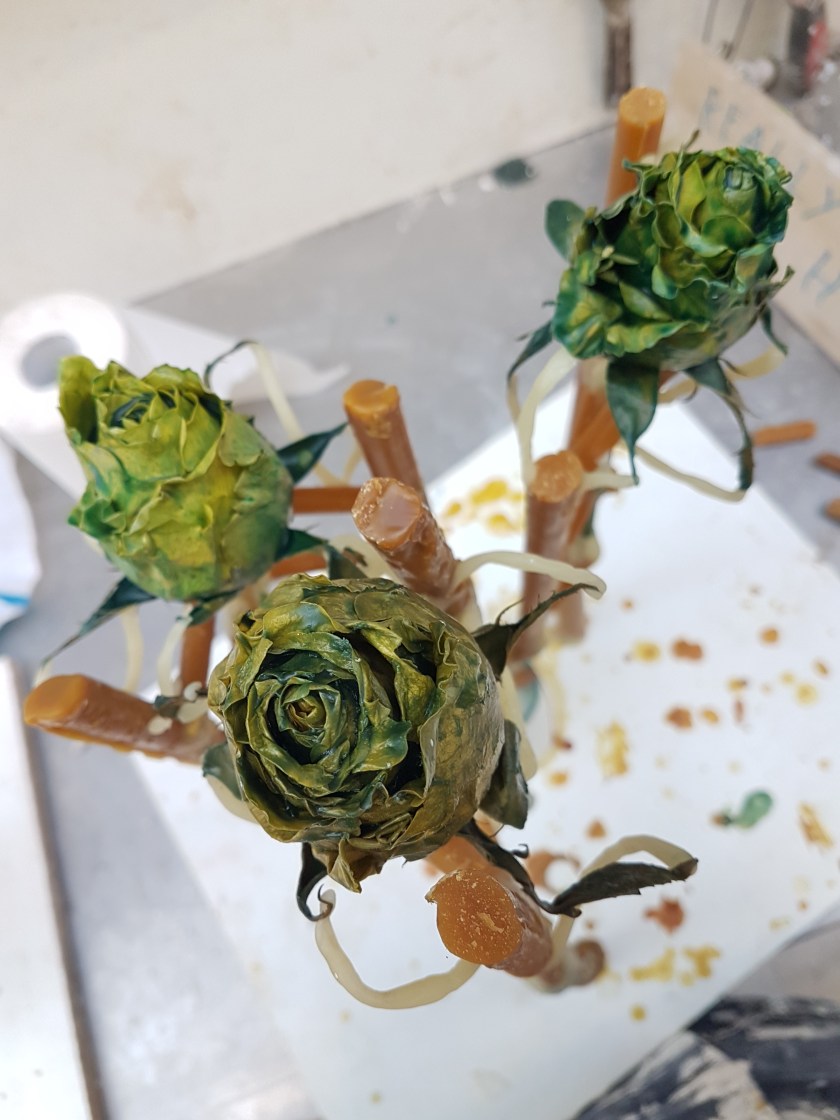
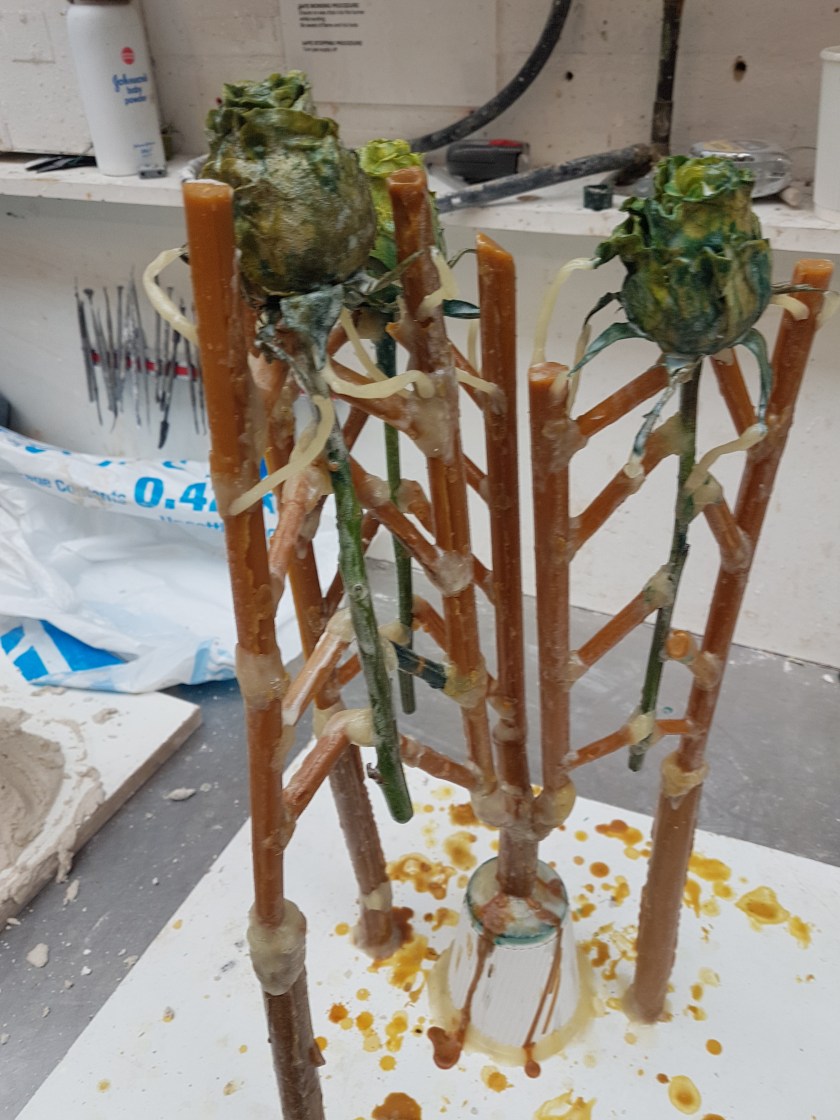
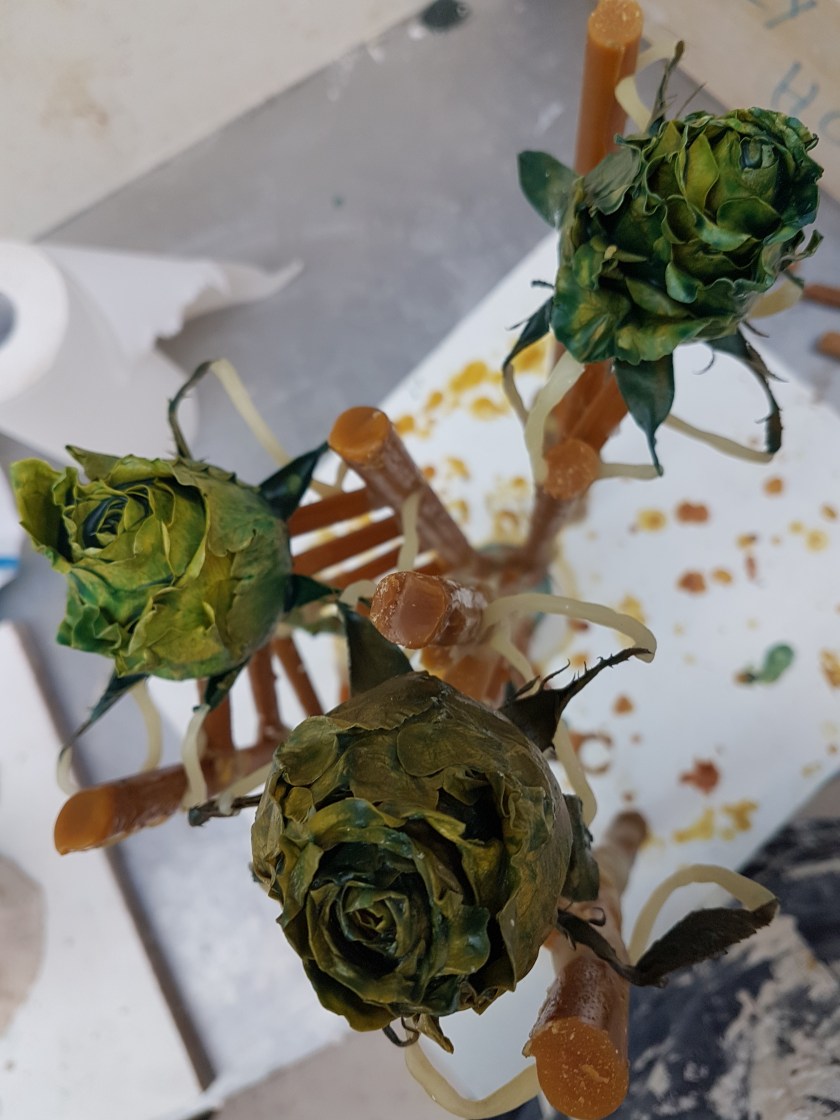
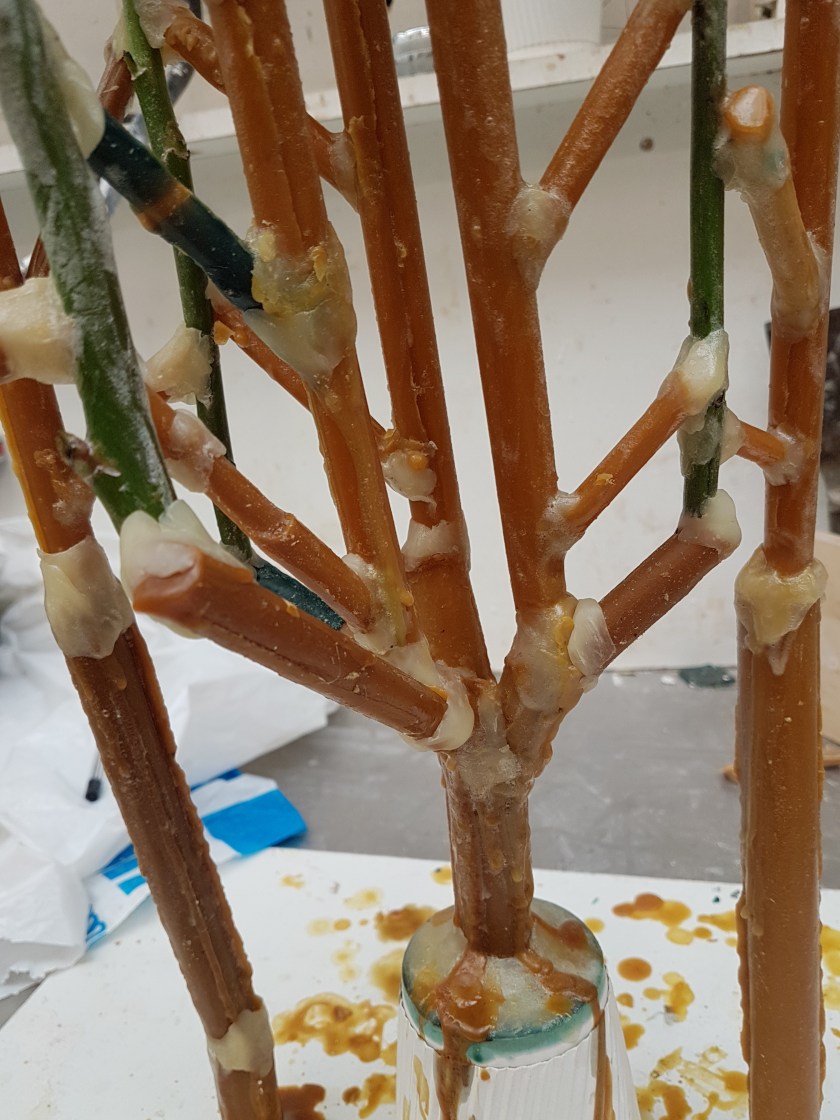
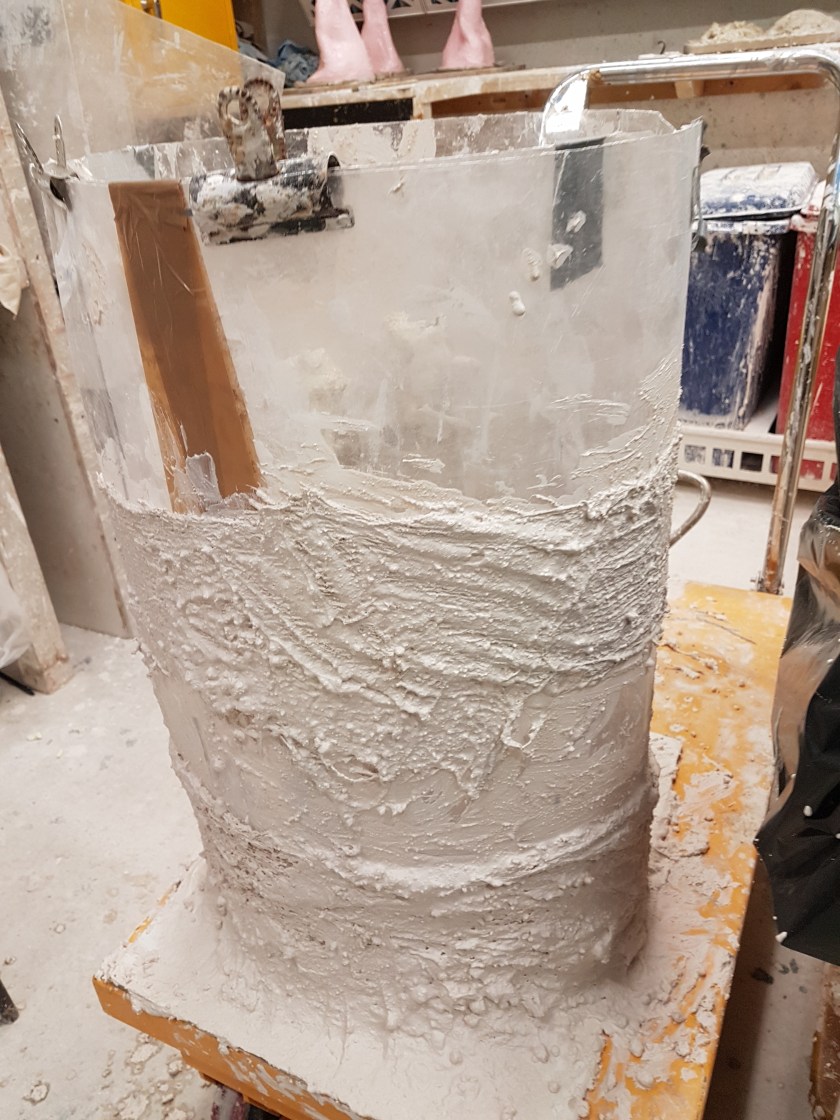
Today I got the third and final rose ran up, then attached to the cup with the rest using hot knives and wax. Then I painted a layer of shellac over everything, to help the grog to stick to it, and once it was dry I covered it all in first coat grog.

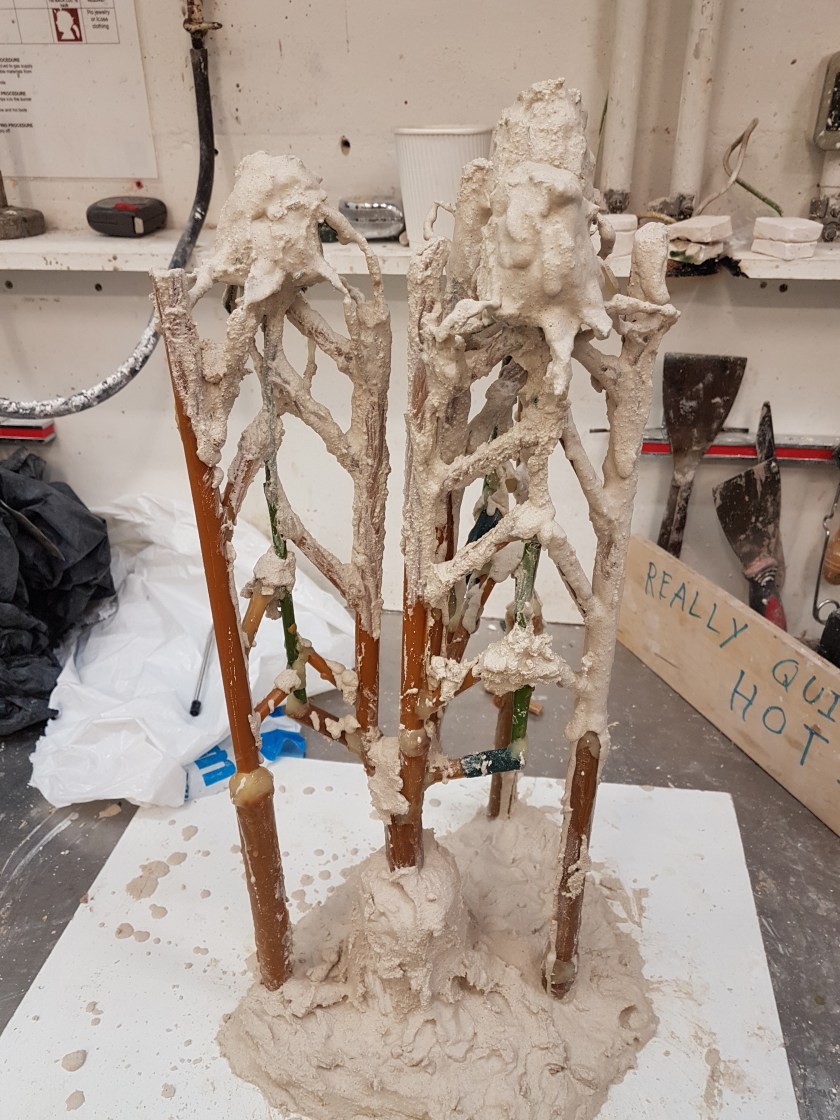
Once that had set we put the plastic cylinder over it all, and I layered scrim (netted fabric) and plaster along the bottom, to seal the cylinder to the board, and around the middle of the cylinder for stability. As soon as this was set I spent the rest of the afternoon mixing and pouring second coat grog, to fill the entire cylinder to make the mould ready for the kiln.

Really proud of my progress today! Got loads done, and worked hard to get the mould ready for the kiln. It doesn’t look like I’ll have a chance to pour before the break, but at least when I get back it will be all ready to go.

Modern Couples:Art, Intimacy, and the Avant-garde at the Barbican

Exhibition Reviews

20181129_093015

(a photo taken by myself from the talk at the beginning, as no photos were allowed in the actual exhibition)

“Modern Couples presents a different way of looking at Modernism in art, as seen through the lens of the artist ‘couple’, an elastic term encompassing all manner of intimate relationships that the artists themselves grappled with, expanded, embraced or refuted.”

– From the official booklet for the exhibition

I visited the Modern Couples exhibition today! I was immediately struck by how well thought out it was- the guide spoke to us at length before and during the tour about the level of research and planning that went into this show, and it was apparent throughout how carefully curated it was. The experience of the exhibition is that of a journey, told through the curation of works and couples chosen, the design and layout of the pieces and quotes, the architecture of the space, and the strong visual branding throughout (I appreciated the title font, but I’ll spare you from my inner typography geek!) An especially interesting use of space was for the section on the ‘Temple of Friendship’ and the women who were part of it. It was built to mimic the oval shape of the temple, blocked off from other sections with heavily draped curtains, with a circular display case at the centre. It definitely added a sense of reverence, but also of safety. The ground floor of the gallery is specifically built to invoke an intimate feel, with the works contained primarily focused on the body, and each section dedicated to a different couple, like a small shrine to each. Upstairs the space is a lot more open, with the work becoming increasingly more abstract as you pass through. It simultaneously felt both familiar and yet separate from downstairs.

The most exciting part of the exhibition was the idea that ‘couple’ doesn’t always necessarily denote a romantic pairing. This is an unusual idea that I don’t think has been explored enough- as they said ‘couple’ can be a fluid term for all kinds of relationships, and some of the ‘couples’ in the exhibition were actually polyamorous groups of three or more people. I think this expanded idea of what a couple can be is challenging the old ideas of couples and relationships, and I hope it leads to a cultural shift. The guide talked about how art in the 20th century became a platform to be more experimental- a playground or springboard for different kinds of relationships to happen. As a proud bisexual I was really happy to see a variety of bisexual, lesbian, and gay relationships portrayed- I had not previously heard, for example, that Salvador Dali had an intimate relationship with a man- and it is important to LGBTQ+ people to see that we have always existed, and are finally getting the recognition we need.

As a non binary femme person it was particularly refreshing to see women placed on an equal footing with men, with their contributions given the consideration they deserve. I enjoyed seeing the role of muse flipped by the work of the women displayed, objectifying and exploring the male figure in the same way that we usually see reserved for the female figure. It was equally refreshing to hear about all the women artists who were pushing and playing with the boundaries of gender- it shows that non binary gender identities have always existed, contrary to what a lot of people still think. I wish that there had been more trans artists included, as they must have existed, but I appreciate that the curatorial team had a pool of 300 or more couples to choose from for this exhibition; perhaps a future exhibition could focus solely on LGBTQ+ artists from this period and their impact on modern art.

Whilst the exhibition doesn’t shy away from the negative and unhealthy sides of relationships, such as objectification and obsession, and is at times a very honest examination of what relationships can become I am, however, critical of one thing. I feel that mental health/mental illness could have been explored in a more nuanced way. Many of the people featured in Modern Couples ended their own lives, and in some cases took their partners life, at least in part due to the unhealthy aspects of their relationships, and although the topic is dealt with sensitively I felt it could have been discussed a little more frankly. I appreciate that this can be difficult when looking at people who are no longer here to speak for themselves, and when you consider that mental health/mental illness was even less talked about or recognised as legitimate in the 20th century than it is today. I understand that this all makes it hard to find out about mental health of the artists displayed, so I am not sure how it could be approached differently, but it is something that could be considered in future. I wrote in my notes that it would have been nice to see some positive endings for artists with mental health issues, but even today many people don’t even realise someone is unwell until they take their own lives, so I understand that this is wishful thinking.

All in all it was a really eye opening experience, finally shining a light on all the amazing women and LGBTQ+ people behind the great male artists of the 20th century, I would recommend it to anyone who has in an interest in modern art, especially those who would like to delve a little deeper into the relationships that fuelled some of the most progressive and innovative art ever made.

Plaster Room 29/11/18

Work in Progress

This slideshow requires JavaScript.

I am putting the leaves to one side for now, they have been dipped in wax so they should stay in a usable condition over the break. The above photos show the process of prepping the wax dipped roses to go into a plaster mould- Lindsey was showing me how to do it in a different way from how I have previously made moulds with Becky, essentially working the opposite way round- you can see one of the roses attached to the cup, and the cup attached to the board. Once all three roses have a system of runners and risers they will be attached to the cup in the same way. The next steps will be to degrease it all, put a cylinder around the whole structure, and pour the plaster mix into it to make the mould for the kiln.

I have decided to focus on the roses as I realised that the roses will go beyond simply being a gift to my mum and my nan. I began to think about the ideas behind preserving something that is normally fleeting- roses die and dry out quickly, yet the bronze casts never will. Not only will they outlive any real flower, but they will outlive myself, my mum, and my nan, too. I was inspired by my classmate Gabby’s documentation of her family, and I think I would like to photograph each of us individually with a rose, and then as a group, to capture the moment of gift giving in time, much like the roses are being frozen in time by being cast in bronze. I have also been thinking about how, in time, I will end up with all three roses- my mum and my nan will at some point no longer be around- so it is almost like I am loaning them to my mum and nan, knowing that one day I will get them back. It is a reminder of our own fragile mortality, and also raises the question of who will inherit them when I die. I chose roses as they have a particular significance to my mum- they were my dad’s favourite flower and since his passing she has always bought yellow roses for special occasions, and when she is feeling low, as a way to feel connected to him and his memory. My nan and I frequently buy my mum yellow roses when she is feeling down, and it is my intention to try and patinate them a yellow colour, if this is possible.

TO DO:

  • discuss the idea with my mum and nan
  • get the roses into a mould ready for the kiln
  • ask Gabby for some photography pointers, if she has time. I really admire the sentiment behind her projects, but also the way she executes the photographs is really beautiful, and I am not very experienced with photography so I want to ask her some technical questions about lighting and such
  • look at Louise Bourgeois work- her work often deals with her feelings surrounding her own mother, and a lot of her work is also sculptural so it is a relevant reference