
UNIT 2
3D Printing iPad Scan
river project, UNIT 2, Videos, Work in ProgressThe scans using the iPad didn’t pick up much detail, but captured the shape of the bone quite well- I then used Meshmixer to try and get rid of the pen I used to prop up the bone, which was harder than I expected- cutting it off was the easy part, but I struggled to figure out how to seal up the hole left in the mesh. I haven’t shown this part in the video, as I forgot to record it, but you can see on the 3D print where I dragged the mesh across in an attempt to seal up the hole, so I definitely need more practice with this! Overall though I am very happy with how the print came out, for a first attempt I think I did a good job, and going forwards I know I need to practice messing around on MeshMixer to make my other 3D scans and prints look better!
I am planning on scanning the rest with the iPad as well, to see what they come out like, and to act as a back up in case I can’t get them to work with photogrammetry in time.
Group Presentations- Feedback for Gabby and Arlette 24/01/19
2ND YEAR PRESENTATIONS, Tutorials, UNIT 2Gabby:
- “connection, or lack thereof”
- connections shown in Gabby’s work, focusing heavily on family and familial connections
- research into lack of connection
- Gabby’s imagery is all beautiful and well thought out, with clear focus on composition and lighting to emphasise the subjects (or lack thereof) to convey a message
- “when or where do you feel in tune with your most honest feelings?”
– for me personally either when I am with my best friend or during yoga - your “honest feelings” change frequently and aren’t fixed – you could research why this is?
- can you think too much? In modern society are we constantly putting off and distracting ourselves from our true feelings?
- suicide is a very tricky and difficult topic to discuss and make work about and should be treated delicately, especially if it is not something you have personally experienced (i.e. loss of a loved one by suicide or experiencing suicidal thoughts/ideation)
- Nitschke’s “suicide machine” – Sarco pod
- do images always need text to explain them?
- spontaneous v.s. staged, curated imagery
- Gabby’s body of work is gorgeous, varied, and full of emotion communicated purely through image
- photographers crossing moral boundaries- Gabby obviously has permission from her family to create her work, but other photographers often lack these permissions
- Gabby’s work is authentic and powerful and she obviously carefully curates her images to convey the message she is aiming for
- you recognise when outside influences have impacted your work and are honest about it
- tackling sensitive topics with compassion
- your work combines thoughtfulness and emotion with strong technical skill
- how will you present your work? With or without text explanations? are the titles enough? Especially with the project about your friend
- your work seems to be more about the feeling than the story- your work evokes feelings in the audience and encourages them to bring their own stories to your work
- your work almost presents us with a blank story board or template, that we, the viewer, can insert our own stories into and bring our own feelings to
- well put together presentation and I enjoyed physically handling your prints!
Arlette:
- Why is art purely visual? How can we make art more interactive?
- “Interactive” v.s. “Practicability”
- sensory art- art that uses all the senses get viewers more in tune with themselves, the environment, and each other
- how do we get the audience to interact with our work- this is something I am struggling with in my own work- most gallery goers are used to the unspoken rules of not touching the work
- playfulness, familiarity/comfort, space, feedback- key to getting audience to interact
- how interactive do you want to be? Yayoi Kusama’s Infinity Rooms v.s. Olafur Eliasson- are there constraints? What do you want, as the artist?
- why do you want the work to be interactive? How?
- online questionnaires, hashtags, paper feedback forms, “leave a comment” box/board, invigilating, recording the space, speaking to the audience in the space
- art as a community- art can build a community, it can also exclude people from that community, or create a sense of community
- “Art is not just an object it is a sense of community” – Eliasson, 2012
- “The turbulent storm of potential meaning”
- Object as a representation of the “individual” in Western society, interactive art steps away from that and encourages the audience to engage as a group rather than as individuals
- strong body of research- it would be good to see more practical experimentation to back up or disprove the research you have done
- interaction as a tool or medium to explore different topics
- I would like to see more of your practical work and how it links in to your research topics (i.e. your paintings as I think they are amazing!)
- your presentation was well put together, very interesting, and I think it would be cool to collab on a project some time, as we are both exploring the topic of interactivity in art
3D scanning photogrammetry
UNIT 2, Videos, Weekly Summaries, Work in Progress
The set up for photogrammetry is the same as for scanning with an iPad, as you can see from the set up photos above. Much like the iPad you need to capture a full 360 of the object you are scanning, however the process takes longer, and is harder to get right. You have to take around 50 images of the object, moving very slowly around it as you photograph, making sure to keep the camera the same distance from the object and the same angle as you do it. These photos then get uploaded into a programme called Autodesk Recap Photo, which stitches your photos into a 3D model.
The images included above are of one of the first attempts to scan one of the bones using this technique- unfortunately the back of the bone didn’t come out.
the video above shows what I mean better- although the detail has been captured beautifully, only half of the bone has come out as a 3D model. I tried a few times with no more success than that, and the software takes a long time to make the model only to find out that it hasn’t worked. I might need to find another method of 3D scanning, as the iPad scans lack the detail that I want, but photogrammetry is proving to be really difficult!
Group Presentations- Feedback for Vanessa
2ND YEAR PRESENTATIONS, Tutorials, UNIT 2- Joseph Beuys– “anyone can be an artist”
- Art as communication
- Art is for everyone and should be for everyone
- There should be an inherent value to all art, regardless of monetary value or quality, which is highly subjective
- Can art be used to help people/ bring people together?
- Adolf Loos– ‘Ornament and Crime“- a relatively short read that could be used as a counter argument
- “Social sculptures“- interesting phrase from Joseph Beuys video- using his “social sculptures” to communicate to a larger group of people
– using people’s innate urge to be part of a group or community to get people involved in his projects
– using those projects as a way to influence those people and get them to listen to his ideas
- Using your platform or your skills in a certain medium to engage socially and open up the dialogue- aka musicians using their music to be political, artists using their art to get a message across, writers writing about things they feel strongly about
- Anselm Kiefer– trying to make the people of Germany “feel” again
- Refugees travelling to Greece- graves, life jacket installation
- “History is a material” –regimes can manipulate history as they see fit
- Examining how the societies and times artists live(d) in influence their thinking and work
- You could strengthen the links between post war Germany and the modern day situation with the Middle East?
- Etching idea sounds promising- you could look at Francisco Goya and his etchings of the Spanish Civil War
- I think it would be worth looking at artists making work about refugees and modern conflict (i.e. the Middle East) particularly artists who were or are refugees as they have first hand experience- much like Beuys and Kiefer had first hand experience of WW2 and the aftermath
- Justin Mortimer- wasn’t sure how he relates to the other two at first
- Mortimer creates new mythological narratives through painting collages of seemingly unrelated digital imagery- much like how the first two artists created their own mythologies
- Dream v.s. Hope, the lofty aspiration v.s. the slightly more achievable goal
- How do you take a dream and turn it into a more realistic, but still satisfying, goal?
- “La Mitrailleuse” (“The Machine Gun”) by Christopher .R. Nevinson- artist whose style changed dramatically over time with the changes happening around him- WW1, WW2, ect
- See also Paul Nash
- Have we suppressed the feelings of and memories WW2 too much? Has that allowed the resurgence of Neo-Nazi ideals and the rise of other conflicts and regimes?
On another note, I think you put together a really well thought out presentation- the material was clearly divided into sections, the links were mostly strong, and the videos helped to break it up and make it easier to engage with. You just need to pull this back into your practical work and keep making!
3D Scanning using iPad 14/01/19
river project, UNIT 2, Videos, Weekly Summaries, Work in ProgressThis video is of the Digital Media Technician Adamina demonstrating how to use the 3D scanning software and piece of kit for an iPad. This is one of the more basic 3D scanning techniques available, and as you can see the scan hasn’t picked up the details of the bone, only the rough shapes.
The next step for me is to install a free programme called MeshMixer and cut off the pen, as it came up in the scan, and seal up the piece. Then it will be ready to be 3D printed on Monday next week.
These photos show the set up in the studio, including white backdrop, plinth, and lighting set up. We suspended the bone from nylon wire so that we could scan the whole object, and used a pen and blueback underneath it for stability- we needed it to be still for the scanning to work.
Next Steps:
- download MeshMixer and clean up the scan for printing
- meet with Adamina next Monday (I have booked an appointment with her) and send the scan to print
- hopefully next week we will also experiment with photogrammetry, which she mentions in the video. This process is a bit more lengthy and complicated- I will have to borrow a camera and lens from uni, and photograph the object multiple times from multiple angles, and then upload these photos to a specialist programme that stitches everything together to create a 3D model. This will take a fair bit of time, and I might still need to work into the objects on the software to clean them up before we can send them to the 3D printer
Silicone casting 15/01/19
river project, UNIT 2, Videos, Work in ProgressI decided to make silicone casts of the bones, to explore a different material and its potential for my project- and luckily someone else in the foundry also wanted to work with silicone too, so Lindsay mixed up the last bit of silicone she had for us both to use. Unfortunately there wasn’t enough to cast the brick or jaw pieces, so I may revisit this material once she has more in stock. The photos above show the process- weighing and mixing the two parts of the silicone, then pouring it into my moulds, the same as when I used the wax and plaster, as well as photos of the silicone bones de-moulded.
The above video shows clips of all the bones, and demonstrates the qualities of the silicone- as you can see it is a very tactile material that I have had a lot of fun playing with! There is something very surreal about squashing a pink bone in your hands, and being able to fold it then watch it spring back when you let go, and I am very happy with the results of this experiment.
When I get the chance to present these to the class the main feedback I want is whether or not to cut off the excess silicone- the bronze and aluminium casts don’t have the “feet”, but the plaster and glass wax pieces do, so this is something I need to consider when deciding what to present and how in the final exhibition.
Weekly To Do List 14/01/19
river project, UNIT 2, Weekly To Do ListsMonday:
- Morning – help prep sandpit and mould for the pour in the afternoon
- 12pm- meet Adamina and experiment with 3D scanning and printing
Tuesday:
- Morning- Glass wax cast the jaw pieces and redo the brick
- Afternoon- start making silicone casts of bones
Wednesday:
- I have work in the evening so I will probably rest during the day
Thursday:
- 10am – 12pm Group tutorial
- Continue casting in glass wax/silicone/polymer plaster (brick)
- Work on aluminium bone casts?
Friday:
- Photograph pieces so far
- Continue working on presentation for 7th March

Glass Wax Tests 11/01/19
Photographs, river project, UNIT 2, Videos, Weekly Summaries, Work in Progress
Some photos taken of the process of casting with glass wax- the melting glass wax, the casts full of glass wax, and photos of the failed jaw bone casts and brick cast. Casting the brick hollow with glass wax is proving troublesome- the wax is very brittle and the sides of the cast keep breaking as I try to de-mould it. I will try one more time to cast it hollow but a bit thicker and if that doesn’t work I might have to cast it solid instead. The jaw bone pieces kept failing as the glass wax is too thick and not hot enough to flow all the way through the moulds- I will try to get it hotter next time, but I have to be careful in case the wax gets too hot and the colour changes.
Video demonstrating the properties of glass wax and the casting process.
I wanted to explore the properties and materiality of glass wax, and these are the results so far.
Clip 1: the chunk of unmelted glass wax, demonstrating what it looks like before it is melted and cast- you can see how the light refracts and passes through it.
Clip 2 and 3: the glass wax as it melts, showing the viscosity and how it stretches and flows much like real glass when in molten form. It is very different to other waxes I have used in the past.
Clips 4 and 5: the first attempts at casting the jaw bones in glass wax- as you can see the wax didn’t flow completely through the moulds as it was not hot enough and cooled too fast. I will try again but with the wax much hotter so hopefully it will flow through the moulds properly.
The rest of the clips: the other bone casts in glass wax.
These photos show the second attempt at casting the jaw bones in glass wax (still not hot enough), the glass wax casts all together, the broken hollow brick cast (the details were captured beautifully, it’s just a shame that the sides broke), and one of the glass wax casts lit by Jonathan’s phone torch- as an experiment to see how light travels through them. I think going forwards I would like to photograph the glass wax pieces with a light source beneath them like this, but using a more professional set up.
Notes on glass wax:
- Properties- melts differently to waxes I have used in the past (i.e. the green and orange waxes used in uni, soy wax, paraffin wax, beeswax)
- As it melts it goes quite stringy and is still very thick and viscous, can be stretched into glass-like threads that look like nylon thread
- It sets VERY quickly and needs to be quite hot to pour well, but you have to be super careful not to overheat it as it can make the wax change colour
- You can add oil paint as a pigment to glass wax, but I’m more interested in how it looks originally- like a translucent glass
- I might do one or two in colour just to see what it looks like, but we’ll see
- It is quite brittle- I tried to make a hollow brick cast and the sides shattered (like glass) as I tried to remove the cast- if I retry this I will need to make it thicker
- It picks up detail really beautifully and I’m definitely impressed
- I need to redo the jaw bones in glass wax as the wax wasn’t hot enough and as a result didn’t flow through the moulds properly
Group Tutorial Notes 10/01/19
Tutorials, UNIT 2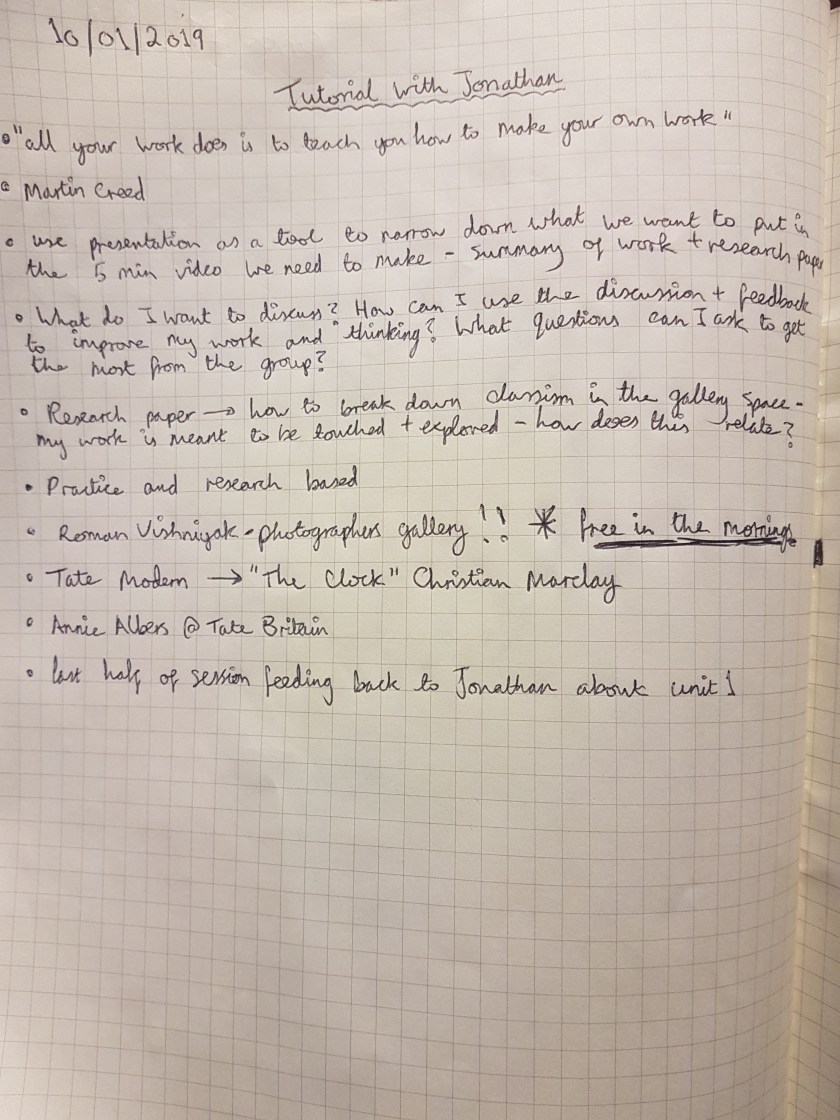
 KAT OUTTEN