
- I had never heard of this artist before- I saw a post on Instagram of one of her fabric sculptures and decided to drag my friend along on a whim
- a really surprising breadth of work
- paintings ranging in size, large fabric sculptures, an installation of a living room filled with these strange, vaguely human fabric shapes, drawings
- I’m not usually that wild on paintings but I really love the use of color, layering, and the suggestions of shapes and figures that blend into each other seamlessly
- the fabric installation was really unsettling and creepy- loved it!
- The exhibition was curated really well- the use of color walls to highlight certain pieces was very effective and I enjoyed seeing a deviation (no matter how small) from the standard white walled gallery space
Author: Kat Outten
I Can’t Help the Way I Feel- My Fat Body
UNIT 2, Videos, Work in Progress
An artwork exploring my relationship with my body existing in a culture that simultaneously glorifies and vilifies food and sells diet culture to the masses. Interspersed with clips of my own body are clips of the John Isaacs sculpture “I Can’t Help The Way I Feel”, previously on display at the Medicine Now exhibit at the Wellcome Collection in London, which depicts a vaguely human form (without the head, arms, and genitals) engulfed in an explosion of fat. This video piece is both a response to that work, and a work in it’s own right. Ideally I hope to display this in an exhibition with works made by other fat artists, projected onto a wall at a large scale, so that it cannot be ignored by the viewer. I would also like to make casts of various parts of my body to display in the space, so that the audience is confronted by other kinds of body to what we are force fed in the media- tiny bodies, with only certain parts deemed acceptable to be large (i.e. bums and boobs on women, usually- but only if they are smooth and free of cellulite and stretchmarks).
A large part of my struggle with my body image comes from the outside world, from society as a whole. The footage of the bacon roll (a Greggs advert) represents the constant imagery of fast food that we are bombarded with, from television adverts to posters and even giant billboards. Being in London, particularly, means we are constantly surrounded by this, as the city is saturated (pardon the pun) with images of food. At the same time we are also assaulted with images of the “perfect” body, whether that is on the front of every magazine, or for diet pill and fitness regime ads on the tube. This constant war between the food we are reminded is unhealthy, and images that show bodies like mine as the “before” all contribute to my twisted self image, and have fueled my disordered eating for years.
The “we’ve shed the pounds” footage is not from a health or fitness shop though- it is from the window of an EE phone shop. Clearly they are advertising that they have made their products cheaper, but the wording and the imagery of the scales alludes to weight loss- on a shop that has nothing to do with weight! I thought that was pretty ridiculous, which is why I filmed it and included it in this piece. I may also record some footage of the diet and fitness ads on the tube next time I use the underground and add it to the video at a later date, as I feel that would fit with the work. I would also like to play around with adding sound to the piece- I considered recording myself reciting some of my writing and poetry on my body, but I don’t really like the sound of my voice, and someone else’s voice would not work as it is a personal piece. I feel music would be distracting, so I might ask some people I know who work with sound to help me come up with something, as I feel the work could benefit from it.
This is definitely a work in progress, and I am excited to see what I can do with it in the future! When I finish my MA I think I would like to get a group of fat artists together to put on an exhibition and run some drawing workshops in the space, inspired by my original Fat Bodies Drawing Workshop for the Post Grad Community at my uni, but bigger, better and fat artist only! Perhaps this work will be part of it, but perhaps I may have moved on to a different piece by then.
DRAW- Yu Chen Wang
Lectures/Talks, UNIT 2“Drawing can be a very simple and effective method of communication” – Yu Chen Wang
As part of the DRAW reading group led by the Post-Grad Community we had the pleasure to welcome artist Yu-Chen Wang, a London based artist from Taichung, Taiwan. Her practice primarily focuses on drawing, where her work treads a delicate line between control and chaos- she does not do any preparatory drawings, instead opting to sketch straight from her head. Combining her drawings with props, lighting and various structures to create immersive multimedia exhibitions, her work is proof that drawing can exist outside of the paper it is drawn on. She blends her work with performance, as a way to organise people’s movement without their knowledge within the exhibition space, and as a method to communicate with people.
Yu Chen’s work draws from a variety of sources; her interests span topics from theoretical physics, archaeology, and archives, to historical waterways and buildings in the many cities she has visited, and this variety of source materials reflects in her work. Her references include archival materials, draftsman drawings, and photographs. One project in particular that I found inspiring was the project We Aren’t Able To Prove That Just Yet, But We Know It’s Out There (2018-19), developed with Collide International Award, a partnership programme between Arts at CERN and FACT (2016-2018).

(We aren’t able to prove that just yet, but we know it’s out there 2018 150x270cm (detail)
Video and image taken from Yu Chen Wang’s website
This project, in her words, was about “making the invisible visible”, exploring “the abstract photographic images produced by the Bubble Chamber experiments in the 1960’s. Wang was fascinated not only about what they detected –the paths of short-lived electrically charged particles– but also the whole process which surrounded their documentation and interpretation.” (excerpt taken from her website).
As part of this she spent six hours listening to a retired theoretical scientist explain particle physics, and it was this, as well as the variety of archival materials she collected and researched, that formed this project. She also spent a lot of time whilst researching talking and listening to current and former scientists, soaking up their knowledge to enrich herself and the project- she spoke of loving to learn, and this desire for knowledge as being a driving force behind a lot of her work. Her interest in the unseen labour behind most scientific discoveries mimics artistic practice, with many failed experiments, tests, and preparatory work culminating in a final presentation to the outside world. I admired her dedication to learning about this complex topic, and the way she interpreted it has a very unique perspective- she combines her drawing with sound and video to create installations that absorb the viewer. I would love to have the opportunity to see the work in an exhibition space, as I feel that watching the video and seeing photographs in the lecture did not do it justice- it definitely needs to be experienced in its entirety.
Her work proves that art does not, and indeed should not, exist in a vacuum; that artists should be open to exploring other topics, and be able to take inspiration from anywhere. Being able to do this can make art much richer and we, as artists, should strive to connect with different people, and engage with everything we possibly can. Yu Chen Wang’s is fundamentally about communication, and a desire to connect with others, and at her core Yu Chen is just a person seeking to communicate and forge genuine connections with people through art.
TO DO LIST- Spring Break
UNIT 2, Weekly To Do Lists- edit video clips of 3D Scanning and printing and upload to Vimeo/Youtube then add to draft post and publish
- make work for the Mentally Chill exhibition exploring mental health
- make fat video piece
- Organise exhibition- make or get someone else to make promo materials, apply for Student Iniative Fund, go through submissions, select work, email those selected, book/source equipment, organise private view and events to happen whilst exhibition is up
- Type up Dorothea Tanning notes into blog post and add photos
- Add photos/videos of the exhibitions we visited during the Low Residency and type up notes into blog post
- finish blog post on my presentation and feedback
- finish typing up Ziyan’s feedback
- edit video clips of photogrammetry first attempts and post along with notes
- Edit video clips of Peckham project for Low Residency and add photos and notes to blog post
- type up notes and add photos from the talk given by Professor
Presentation- ISMs in the Art Gallery 07/03/19
2ND YEAR PRESENTATIONS, Assessment, river project, UNIT 2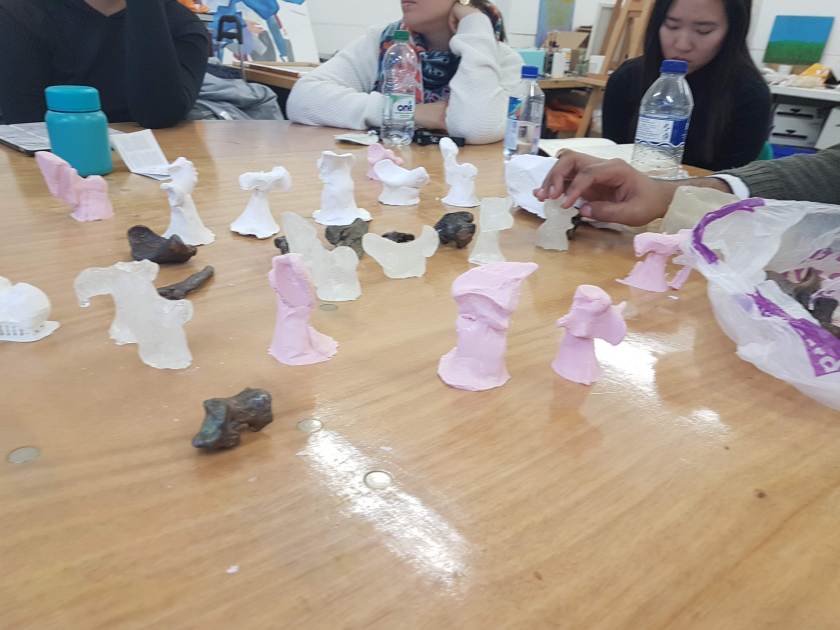
I have linked my presentation, above, and the photo shows all of my casts so far laid out on the table during my presentation.
During my presentation I wanted to focus on how my river project is about engaging the audience and being more interactive than your average piece of art, and how this links to my research paper topic of classism in the gallery space. I feel that work that is purely visual leaves out a lot of people, specifically those with visual impairments, and can also put off children and those who prefer tactile work, so I wanted to combat this by making work that is meant to be touched and handled by the audience. Engaging the audience in this way can be effective at breaking down the barriers many people, particularly those of different classes, age and abilities, face when visiting art galleries and museums, and I feel this is vital if we want the art world to be a more inclusive and diverse space. I was keen for my classmates to pick up and interact with my work and get their opinions on it, which is why I laid out all the pieces I have made so far out on the table for my presentation.
Feedback for Ziyan 07/03/19
2ND YEAR PRESENTATIONS, Tutorials, UNIT 2- Guy Debord comments on the “society of spectacle”
- linking French theory from the 20th century to what is currently happening in China- I thought this was very apt and interesting to consider
- Lin Yilin and Liang Juhui- impromptu performances that interact with public spaces, playing with the idea of the spectacle
- Caofei.com – I particularly liked this artists work!
- Xu Zhen supermarket- playing with the idea of consumer culture, and what people will actually buy
- where next? What do you see as the final outcome for your work, in regards to the show?
- dealing with feelings through materials, taking ownership by deconstructing physical memories
- who do memories belong to?
- “Memory as an Illusion”, book by Julia Shaw- borrow this from Gabby!
- “Gaslight”- a film by Alfred Hitchcock examining memory and manipulation
- I would like to see more research into memory and more experiments and work exploring your topics!
Surviving and Thriving as an Artist- Rosalind Davis, Notes
Lectures/Talks, UNIT 2Notes made during the talk by artist, curator, teacher, writer and consultant Rosalind David
- Managed and curated CORE gallery in Deptford
- Zeitgeist Arts Projects- ZAP- artist run organisation co-founded and ran with Annabell Tilley
- “What They Didn’t Teach You at Art School”- her book
- what other values do you have? “Making it” looks different to everyone
- getting opportunities- meeting people, building contacts, keeping in contact, promotion, research, seizing opportunities, building a good reputation, being polite and memorable, being organised and professional, networking
- design the art and career YOU want
- engage in the process- i.e. exhibitions
- be aware of the different kinds of art spaces/organisations and figure out which work best for you
- apply for opportunities- competitions, open calls, DIY gallery proposals, art fairs, festivals, site specific projects, commissions, awards, ect
- get used to rejection but don’t let it get you down
- don’t be passive- pursue things!
- Why have an exhibition?
– to get feedback
– meeting people
– to see your work in a new context
– working with new people
– socialising/networking
– learn from others
– professional reputation
– sell work - email- write a personal intro (show you have researched them) before inviting them to your event go to theirs- build a real connection
- Ways to make money:
– commissions
– funding
– scholarships/grants
– awards
– residencies
– exhibition fees (rare)
– other art jobs - Oli Epp- residencies- PLOP residency
- Selling your work:
– be realistic
– be present
– be prepared to talk about your work
– price it right - Virginia Verran
- check contracts and be careful- get legal advice (Art Quest offers an hour free)
- Arts Council funding- “Develop Your Creative Practice”
- artist statements- find 3 powerful words to describe your work, be creative with language, make it engaging, what and why, spellcheck, get someone to proof read, update it regularly, read it out loud
- Shape Shifters Exhibition- 2nd May
- writing about your work- who, what, why, why here, when
- applying for things- possibilities, timing, dates, assistance, ability to engage, support, workshops, talks, collaboration, community, value, networks, organisation, communication
- UKYA- for 18-30 year olds
- website, business cards, press release, newspapers, social media, research people to invite, peers, re-introduce yourself, be realistic, spend time on things
- Art Quest- careers and employability newsletter – sign up!!
This talk was really engaging and full of useful information for the future- as you can see I made a lot of notes!
Peckham project low res
Assessment, Exhibitions, Group Project, UNIT 2, Videos Low Res Project- Projection Mapping from Kat Outten on Vimeo.
Edgelands Definition:
” Edgelands are the transitional, liminal areas of space to be found on the boundaries of country and town—with the spread of urbanisation, an increasingly important facet of the twenty-first century world ” –wikipedia
Projection Mapping:
” Projection mapping, similar to video mapping and spatial augmented reality, is a projection technology used to turn objects, often irregularly shaped, into a display surface for video projection. These objects may be complex industrial landscapes, such as buildings, small indoor objects or theatrical stages. ” –wikipedia
When we came in on the first day and were told it would be a group project I was very vocally against it. However I actually ended up really enjoying the project and the work we made. We were told the project was to be about “edgelands” and that the final outcome needed to use the technique of projection mapping, but that was all we had to go on.
I think my reservations came from the fact that most of the group projects I have done in the past have gone badly, because I have ended up in groups that haven’t clicked well. In this case though we all got on well- I kind of naturally took on a leadership role without meaning too, as I suggested we could experiment with the weird little Lomax camera I have that has no view finder and 4 lens that go off one after the other, leaving you with an image in four strips. I went back to mine to collect it, and we spent the first day running around Peckham sharing the camera. We were limited by the 3 rolls of expired color film that I had and the fact that it was only the one camera, but we all got on well and shared the camera quite easily, pointing things of interest out to each other and consulting each other before taking the photos. We also all took videos and photos on our mobile phones, just in case the photos on the Lomax camera didn’t work. At the end of the first day we took the rolls of film to Snappy Snaps to get them developed and ready to pick up the next day on a disk.It was actually a really fun, collaborative day, and we also all collected objects from some of the weird shops and market stalls in Peckham which we decided we may or may not use in the piece of work we needed to create.
Day two was mostly spent making the different parts of our installation- Dwa made a painting of Peckhamplex (the cinema) so we took all the photos we took inside the cinema and made that into a film to be projected onto the blank white space on the painting, and meanwhile someone else worked on the clips of the market stalls we collected, and someone else put together the photos from the Lomax camera together, and others played with the composition of the installation, and made the video of the fake fruit and veg to project onto the empty crates we picked up on the streets. It all ended up coming together really well- it looked really dynamic and was an interesting reflection of Peckham Rye Lane. I also really enjoyed seeing the other groups installations as well, I was really glad that I got to take part!
Project by:
Kat
Dwa
Taiyoh
Betty
Vanessa
Ash
Gallery visits low res
Exhibition Reviews, UNIT 2We visited a ceramics studio this morning, and it was inspiring to see that there are so many artist run spaces like this around London- this one is a bit far for me to travel, but would be useful for my classmates based in North London.
Anka Gallery- Aaron Scheer
- mostly multimedia and digital art
- organises regular shows and exhibitions, 4 students a year are offered a show
- bulldog clips used, and plain black frames for smaller pieces
- using screenshots and layering them on iPads and phones
- main themes are digital, interaction with the digital
- challenging ideas of art through the gallery space
- easier to sell print based work than screen based work
- commercial gallery
- authenticating the digital artwork- i.e. USB with a video artwork, limited edition, with a certificate of authenticity
- how do you value digital art? When there is no “1st edition” or “original” how can you market and sell the work?
- the value is often in the certificate of authentication
Arebyte Gallery- Refigure: Ground group show
- VR works, film and animation on screens
- not a commercial gallery- aim isn’t to sell work
- online programme, events, shows
- Arts Council funding
- open calls, always open to proposals
- paid internships
- looking for artists to run workshops for adults and children
At this point my work isn’t very digital, and when I do use digital technology it tends to be a means to an end, rather than something I consider to be work by itself. I think this exhibition has opened my eyes up to the possibilities though, especially regarding the VR work- it was super immersive and it makes art more accessible to a wider audience, which is definitely something I’m interested in exploring further in my own work. The work was very thought provoking but also quite playful, and reminded me a lot of video games. I think I might need to reconsider my stance and explore the digital a little more in regards to my own practice, so it’s food for thought! I spoke to the curator of the gallery whilst we were visiting this gallery, and she seemed keen to get me in to run an event in future- I got her email address and I plan on getting in contact with her sometime soon.
Low Residency 2019, Day 1, 35mm projector experiments and short film
Group Project, Photographs, Uncategorized, UNIT 2, Videos, Work in ProgressSome images of the process, and some interesting test images.
The final video- made using my phones camera, and Gabby’s phone camera, a 35mm projector, various materials, and edited with Premier Pro. The spoken part of the video is me reading out the poem I wrote “An Ode to My Vagina”, which I printed and displayed in the Human Manifesto exhibition at CSM, ran by ArtsFems and the LGBTQ Society.
Another video, this time of various clips recorded and edited- I wanted to show more of my process and may revisit these clips at a later date and reuse them.
Despite feeling really unwell today I made it in and managed to make some work I am happy with, so I’m counting this as a win.
 KAT OUTTEN