Anthea Hamilton- The Squash at Tate Britain

Exhibition Reviews, Photographs

This slideshow requires JavaScript.

Photos taken by me

A solo performer in a squash-like costume inhabits the Duveen Galleries every day for more than six months for the Tate Britain Commission 2018. Each element of The Squash has evolved from Hamilton’s interest in a photograph she found in a book several years ago when looking at improvisational theatre and participatory art practices in the 1960s and 1970s. It showed a person dressed as what looks like a vegetable lying among vines. The original photograph dated from 1960 and depicted a scene from a dance by American choreographer Erick Hawkins. Hawkins was interested in Native American philosophies and he took the form of this costume from the Squash Kachina of the Hopi culture.
The performer selects their outfit for the day from a collection of seven elaborate costumes. Each one is inspired by the original image and by different kinds of squash or pumpkin. The length of the galleries’ terrazzo floor has been tiled in domestic-scale white tiles to create a new environment within Tate Britain’s neoclassical architecture. ”
– taken from the Tate Britain webpage

I recently visited Tate Britain to run a summer school workshop and whilst I was there I got to see one of the performances for The Squash, which I did some blind contour drawings of, below. I tried to capture the movement of the performer, as well as the shapes created by the performer and their interaction with the costume (in particular the large squash head piece), and I felt blind contour drawings would be best for this, as the lines are more fluid, and once made are permanent. I experimented with different pens- fine liners, biro, and felt tips, to vary the quality of line, and as you can see some are far more sketchy and hesitant, whereas others are bold and simplistic.

This slideshow requires JavaScript.

This piece was very enjoyable to watch, as at times it felt like the performer was responding to the audience in the space, and at other times it felt like they were in their own world, inhabiting the physical space whilst not being quite present. Regarding the costume, I particularly liked how it obscured the performers gender- the ruffles and design of it removed the idea of gender from the performance, as well as any other distinguishing features, giving the performer a sense of other worldliness and detaching the viewer from any preconceived notions of gender.

I have recently become interested in performance work for myself- I have always admired performance artists, but had firmly decided for myself that it wasn’t for me, and would probably never become part of my artistic practice. However lately, as my drag project idea has developed, I have found myself considering the idea of taking my drag persona out as a performance. I think the reason I never considered performance for my own practice is largely my lack of confidence in front of large groups, and my fear of being judged or laughed at by others, but I think that challenging myself to perform as part of my art might actually help me to build my confidence. I feel like the gallery space is almost a kind of safe space for artists to try out new things and perform as a character without fear, as audiences are perhaps more open to it, than if I was to take the performance out into a more public space. This piece of work has definitely inspired me to give it a go, and I think it is something I will try in the near future!

Whilst at the Tate I also did some blind contour drawings of pieces from the permanent collection, shown below.

This slideshow requires JavaScript.


Putting the Waxes into Moulds

river project, Work in Progress

This slideshow requires JavaScript.

These photos show the process of prepping my wax bones for the kiln.
Process:

  • I started by pressing the waxes into clay, separated by a layer of cling film to make it easier to remove the clay at a later stage. I built up the clay a little to help hold the waxes in place
  • I then joined the waxes to create runners (where the metal would flow through) and risers (where the metal rises out of) using wax tubes, straws, and sausages of soft wax, depending on the thickness of each bone. I added additional runners made of soft wax to any points on the bone that were smaller, thinner, or looked like they would benefit from it and joined them onto thicker parts of the bones or onto the main runners
  • Once I was happy with how the runners and risers and I had degreased them with meths (to help the grog stick) I then began to layer up the first coat grog mix (2:1 grog and herculite) starting off with a paintbrush to work it into the details of the bones. As the mixture thickened I then pressed it on and built it up around the waxes, making sure not to cover the main runners and risers (the pieces you can see sticking out)
  • When the grog had been built up enough and left to dry I then flipped them over, removing the clay and cling film, so that I could repeat the process of layering up the first coat grog
  • I then needed to extend the runners and risers further, bringing the risers at the bottom up to the top, layering with more grog as I went along, for support
  • As I did this Becky built up a base with grog, which we then used to stand up the separate parts of the mould, building the grog round the sides until it was stable
  • Next we had to get the cup onto the runners, using hot knives to join them and soft wax for additional support
  • Because of the heat we had to degrease and add more grog around the runners for support as we went, as we left one over night only to find that the wax had curved over in the heat
  • I then extended the runners using hot knives to join the pieces of wax tube, and bring them up to the top of the cup, again degreasing and layering grog as I went for support
  • The next stage was to fit a sheet of plastic around the whole thing, which we secured with duct tape, before mixing a batch of normal fine casting plaster. We then dipped some scrim into the plaster and used this to secure the plastic to the base- working extra plaster in to waterproof the join. We also tied some plaster dipped scrim around the middle of each mould to help stabilise it ready for the 2nd coat grog to go in
  • This isn’t shown in the photos but we then filled the mould gradually with 2nd coat grog (1:1:1 grog, ludo and plaster then 2:1 ludo and plaster) until it was to the top of the cup and left it to set

We made 3 moulds this way with the wax bones inside, but I will be uploading a more in-depth video showing the process of the two wax brick moulds once I have finished editing it!

Tutorial with Jonathan 05/06/18

Tutorials
  • Secret Lives of Colour, book
  • Theodore Adorno- colour/white
  • reconciling the conceptual and the making process, balancing
  • Tim Pickup, papier mache work (Drag project ref)
  • Email Jonathan about video game and he will forward it on to MA Illustration
  • papier mache bones?
  • Could the drag crossover into the video game? Could I make characters for the game out of papier mache?
  • build my desk!!
  • work out how I will balance work, making, and research paper over the summer
  • 3D print branch, bones, bottle, brick, rope? Where?
  • final outcome + outcome of the show
  • Science- human and the mind, how the human mind works regarding disgust- BCC programme on it, check BOB, research disgust
  • research materials and perceptions
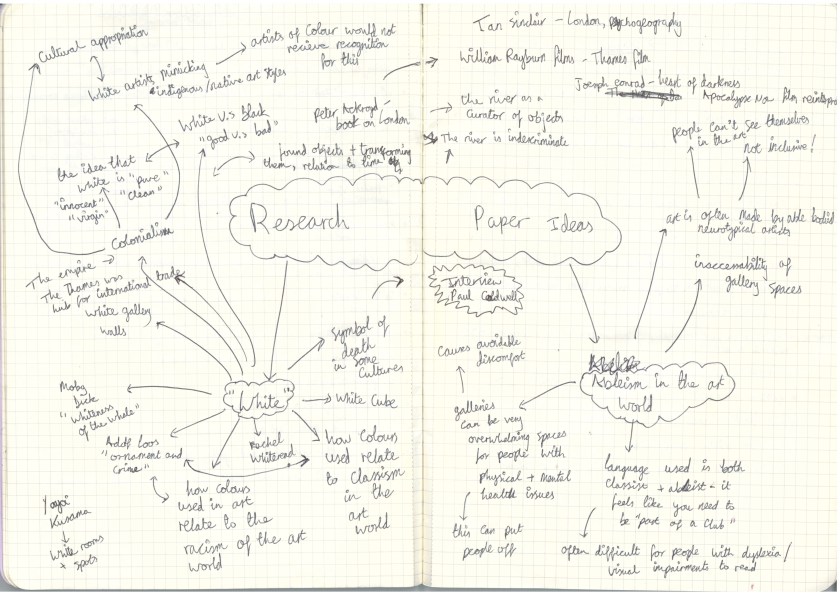
  • galleries and hospitals- why white?
  • does black enhance/dull some colours?
  • grey for Adobe programmes- why?
  • white primed canvasses, Pre-Raphelite, better for showing up bright colours

Emma Gradin, 2nd Year PHD at Chelsea

Lectures/Talks, Tutorials
  • slowing down the gallery experience, through curation, ect
  • talking to artists and spending time with the artworks
  • what do visitors need to know when coming to a gallery and how do we communicate it?
  • are we experiencing the work, or just matching it to the description?
  • what is a studio video? Looking, listening, encountering works, reacting to work, looking at works in progress, asking questions
  • expanded studio visitor- some structured, some unstructured conversations, a meeting and building of mutual respect
  • experimenting with “informational antechambers” – introducing exhibitions with a room of projections
  • translating the visuals into written language- do we need to? Does it help? Can it create more barriers?
  • is it important that viewers/curators know what I was thinking when
    I made the work?
  • looking, listening, discussing, thinking, reflecting, conversation
  • how do you know when a work is finished?
  • how much information is too much?
  • how can we make art more accessible?
  • ableism in the art world and gallery space
  • how can smell, sound, touch, and light slow down the gallery experience?

Dirk Braeckman at Bozar

Exhibition Reviews, Research for River Project (White)

This slideshow requires JavaScript.

Photos by myself

“Dirk Braeckman was invited to the 57th Biennale di Venezia, where he showed a selection of monumental works in the Belgian pavilion. His black-and-white photographs convey a sense of stillness, and combine intimacy and distance to create a private, secluded world whose meaning remains undefined. For BOZAR, Braeckman adapts the project to the architecture of Victor Horta. From Venice to Brussels, from one iconic interbellum building to another.

In parallel, the M-Museum Leuven presents a complementary exhibition on Dirk Braeckman from 02/02 to 29/04/2018. The starting point of this double project was the exhibition of Dirk Braeckman at the Belgian Pavilion during the Venice Biennale 2017.” –https://www.bozar.be/en/activities/128185-dirk-braeckman

Whilst in Brussels this Spring break I came across an exhibition of work by Dirk Braeckman. I had not heard of him before, and after seeing this exhibition I can say I am definitely a fan of his work.

the photos I took don’t really do the works justice- they were huge, and despite being under or over exposed had a lot of detail that could be seen close up. His work had a voyeuristic feel, like peering in and getting glimpses of a strangers life, and the subjects felt both familiar and unfamiliar at the same time, like a distortion of every day life and reality. Whilst at the exhibition I wrote in my notebook:
“haunting, each image is both familiar and unfamiliar, a distortion of reality and the everyday”
“the sea prints are calming and serene”
“The women, with their obscured bodies, seem like ghosts, not wholly present, but a faint memory”
and “The mundane shifts, becoming almost unrecognisable to the viewer”

I often find myself drawn to works that take everyday subject matter and transform them, or shows them from a different perspective, and I felt that connection to his work and my own, even though the mediums are different.

WHITE ROOM AT TATE

Assessment, Exhibition Reviews, Research for River Project (White), UNIT 1

This slideshow requires JavaScript.

  • this room really got me thinking about white, and how it can be used IN art, rather than as a blank space in which to display art
  • by choosing not to use colour the artists featured in this room at the Tate Modern were deliberately choosing to subvert the idea of the white cube space, and of what art could be
  • I used to find monochrome paintings and artworks to be quite dull, but I think now I appreciate how big of a rebellion it can be to choose less colour, especially now, in a world where you can access hundreds of hues and use almost every colour imaginable

Updated Project Proposal

Assessment, project proposal, UNIT 1

Working Title:
What is my Practice and Who am I?

Aims and Objectives:

  • To explore the affects colours and materials have on the viewers perceptions of an object, through my objects collected from the banks of the River Thames
  • To develop a body of practical work exploring colours and materials, through my objects collected from the river
  • To examine the use of white in the modern art gallery- why white? Where did it begin? Is the modern art gallery setup inherently classist? I will explore this through my research paper and visits to galleries
  • To explore myself and my role as an artist through my practice
  • To continue researching for my video game project

Context:
I am continuously reading articles, stalking artists I admire on Instagram, talking to my peers, visiting galleries, reading books, watching media, listening to music, playing video games, and reflecting on my own practice, and this all provides context to my work. Artists that particularly inspire my work include: drag artist Eureka O’Hara, Rachel Whiteread, Yayoi Kusama, Ronit Baranga, Boo Ritson, Claus Oldenburg, Olafur Eliasson, to name a few. To see more of my artistic inspirations visit my PINTEREST . I am particularly interested in art that engages viewers, in work that explores everyday objects in weird ways, and work that focusses on the body currently, although my interests change regularly.

Methodology:
My making process definitely inspires my research and ideas, which is evident particularly in my river project. The display of the white vacuum form plastic pieces I made made me think about the use of white in the gallery space, which has informed my research into white and its use in the gallery space, which is a possible avenue for my research paper. I am constantly making and revising my ideas, and it is this constant revision which has made me realise that the process in the foundry is probably going to take up most of my time at least until the end of this academic year, which means my video game project is definitely going to be put on the back burner and kept strictly to research at this point. As I have worked in the foundry I have also developed the idea of exploring how materials and colours affect the viewers perceptions of an object- and this line of inquiry is now the main thought behind the river project. This has inspired me and my aim for the project now is to recreate my objects in as many materials as I can to explore this. I will continue to document my processes through photography and notes on this blog, and I would also like to do more filming of various stages of the process- I find filming it helps me to remember different stages better, and it is easier to show how to do something via video than it can be via photos and written descriptions. This will also help me to hone my editing skills!

Outcomes:
I envision my final outcomes at this current moment to be an interactive exhibition for my river project- I would like a table displaying the original objects and the casts of them in various materials, including bronze, aluminium, plaster, resin, wax, ceramic, and possibly 3D printed plastic. The idea is that I would encourage the audience to pick up and interact with the objects, whilst observing if certain materials are more familiar or comfortable to the viewer, and if so which. I would hope to discover the affects of the materials and colours on whether the audience are more likely to interact or not with the objects.

I also hope to have this blog as a cohesive record of my development, showcasing a diverse body of practical and academic research that has informed my practice and finished works.

Workplan:

  • Research Paper Submission- November
  • Blog submission- November
  • Finished work in Foundry by December 2018
  • Begin work in Ceramics by January 2019
  • Have a substantial body of pieces for final show in July

Bibliography:

Here is everything I’ve looked at so far for the Perfect Victim Game project, and this is everything I’ve looked at so far for the research paper/River Project.


Casting the Jawbone

Photographs, river project, Work in Progress

This slideshow requires JavaScript.

Casting the jawbone raised a host of issues that I didn’t realise would be a problem, but hopefully it will work out in the end. Before we could make a hot rubber mould of the jawbone Becky (the technician) and I decided to make a plaster cast of the jaw, as we felt it would be too fragile to make a hot rubber mould from directly.

STEPS

  1. Before we could begin casting I had to fill in the holes in the jaw (where the rest of the teeth originally were) with soft wax, so that it would be easier to cast. I also used a little superglue to secure the two teeth- we were worried that they may have come out of the jaw when we de-moulded it, so this was a preventative measure.
  2. I then pressed the jaw carefully into some clay and built up clay walls around it, and then applied a few layers of vegetable oil to the jaw to help release it from the mould once the alginate had set
  3. I mixed up a small amount of quick set alginate which I poured into the clay mould and left to set
  4. Once this had set I carefully removed the clay and rinsed the jaw and alginate, before greasing it up with more oil, and building up clay walls around it
  5. Another batch of quick set alginate was then poured over this, and left to set
  6. The clay was then removed, and the two halves of the mould separated and the jaw carefully removed.
  7. After cleaning both halves of the mould I fit them together and secured them with elastic bands, and was then ready to pour fine casting plaster into it
  8. The first attempt didn’t work very well and only the thickest section of the jaw came out, so for the second attempt after pouring in the plaster I moved the mould around to encourage the plaster to flow through the whole mould
  9. Once I opened the mould up I realised one half had not worked out, and the other half, where all the detail was, was too thin- to fix this I cut up scrim and layered that and some more plaster on top of it until it was thicker and stronger
  10. I then de-moulded it and created a hot rubber mould from that plaster cast. Because the detail was lost on one side I decided to make a flat mould, rather than a round one that needed to be cut open, to save materials
  11. The final photo on the slideshow is of the original jaw, first failed plaster cast, second plaster cast, and de-moulded wax cast of the jaw- as you can see there are a lot of details that need to be worked back into the wax by hand, but I am confident that it is doable