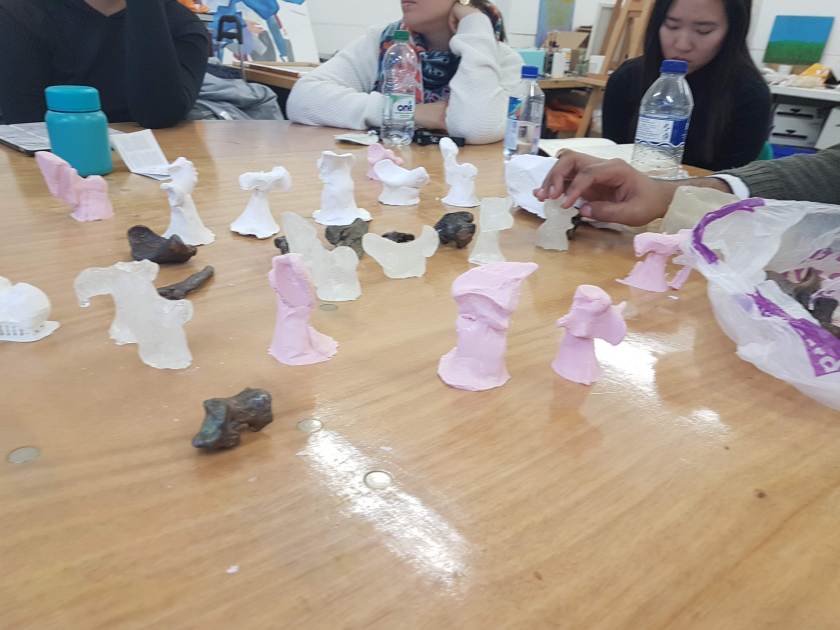
I have linked my presentation, above, and the photo shows all of my casts so far laid out on the table during my presentation.
During my presentation I wanted to focus on how my river project is about engaging the audience and being more interactive than your average piece of art, and how this links to my research paper topic of classism in the gallery space. I feel that work that is purely visual leaves out a lot of people, specifically those with visual impairments, and can also put off children and those who prefer tactile work, so I wanted to combat this by making work that is meant to be touched and handled by the audience. Engaging the audience in this way can be effective at breaking down the barriers many people, particularly those of different classes, age and abilities, face when visiting art galleries and museums, and I feel this is vital if we want the art world to be a more inclusive and diverse space. I was keen for my classmates to pick up and interact with my work and get their opinions on it, which is why I laid out all the pieces I have made so far out on the table for my presentation.
Notes made during the talk by artist, curator, teacher, writer and consultant Rosalind David
Managed and curated CORE gallery in Deptford
Zeitgeist Arts Projects- ZAP- artist run organisation co-founded and ran with Annabell Tilley
“What They Didn’t Teach You at Art School”- her book
what other values do you have? “Making it” looks different to everyone
getting opportunities- meeting people, building contacts, keeping in contact, promotion, research, seizing opportunities, building a good reputation, being polite and memorable, being organised and professional, networking
design the art and career YOU want
engage in the process- i.e. exhibitions
be aware of the different kinds of art spaces/organisations and figure out which work best for you
apply for opportunities- competitions, open calls, DIY gallery proposals, art fairs, festivals, site specific projects, commissions, awards, ect
get used to rejection but don’t let it get you down
don’t be passive- pursue things!
Why have an exhibition?
– to get feedback
– meeting people
– to see your work in a new context
– working with new people
– socialising/networking
– learn from others
– professional reputation
– sell work
email- write a personal intro (show you have researched them) before inviting them to your event go to theirs- build a real connection
Ways to make money:
– commissions
– funding
– scholarships/grants
– awards
– residencies
– exhibition fees (rare)
– other art jobs
Oli Epp- residencies- PLOP residency
Selling your work:
– be realistic
– be present
– be prepared to talk about your work
– price it right
Virginia Verran
check contracts and be careful- get legal advice (Art Quest offers an hour free)
Arts Council funding- “Develop Your Creative Practice”
artist statements- find 3 powerful words to describe your work, be creative with language, make it engaging, what and why, spellcheck, get someone to proof read, update it regularly, read it out loud
Shape Shifters Exhibition- 2nd May
writing about your work- who, what, why, why here, when
applying for things- possibilities, timing, dates, assistance, ability to engage, support, workshops, talks, collaboration, community, value, networks, organisation, communication
UKYA- for 18-30 year olds
website, business cards, press release, newspapers, social media, research people to invite, peers, re-introduce yourself, be realistic, spend time on things
Art Quest- careers and employability newsletter – sign up!!
This talk was really engaging and full of useful information for the future- as you can see I made a lot of notes!
Low Res Project- Projection Mapping from Kat Outten on Vimeo.
Edgelands Definition: ” Edgelands are the transitional, liminal areas of space to be found on the boundaries of country and town—with the spread of urbanisation, an increasingly important facet of the twenty-first century world ” –wikipedia
Projection Mapping:
” Projection mapping, similar to video mapping and spatial augmented reality, is a projection technology used to turn objects, often irregularly shaped, into a display surface for video projection. These objects may be complex industrial landscapes, such as buildings, small indoor objects or theatrical stages. ” –wikipedia
When we came in on the first day and were told it would be a group project I was very vocally against it. However I actually ended up really enjoying the project and the work we made. We were told the project was to be about “edgelands” and that the final outcome needed to use the technique of projection mapping, but that was all we had to go on.
I think my reservations came from the fact that most of the group projects I have done in the past have gone badly, because I have ended up in groups that haven’t clicked well. In this case though we all got on well- I kind of naturally took on a leadership role without meaning too, as I suggested we could experiment with the weird little Lomax camera I have that has no view finder and 4 lens that go off one after the other, leaving you with an image in four strips. I went back to mine to collect it, and we spent the first day running around Peckham sharing the camera. We were limited by the 3 rolls of expired color film that I had and the fact that it was only the one camera, but we all got on well and shared the camera quite easily, pointing things of interest out to each other and consulting each other before taking the photos. We also all took videos and photos on our mobile phones, just in case the photos on the Lomax camera didn’t work. At the end of the first day we took the rolls of film to Snappy Snaps to get them developed and ready to pick up the next day on a disk.It was actually a really fun, collaborative day, and we also all collected objects from some of the weird shops and market stalls in Peckham which we decided we may or may not use in the piece of work we needed to create.
Day two was mostly spent making the different parts of our installation- Dwa made a painting of Peckhamplex (the cinema) so we took all the photos we took inside the cinema and made that into a film to be projected onto the blank white space on the painting, and meanwhile someone else worked on the clips of the market stalls we collected, and someone else put together the photos from the Lomax camera together, and others played with the composition of the installation, and made the video of the fake fruit and veg to project onto the empty crates we picked up on the streets. It all ended up coming together really well- it looked really dynamic and was an interesting reflection of Peckham Rye Lane. I also really enjoyed seeing the other groups installations as well, I was really glad that I got to take part!
We visited a ceramics studio this morning, and it was inspiring to see that there are so many artist run spaces like this around London- this one is a bit far for me to travel, but would be useful for my classmates based in North London.
This slideshow requires JavaScript.
Anka Gallery- Aaron Scheer
mostly multimedia and digital art
organises regular shows and exhibitions, 4 students a year are offered a show
bulldog clips used, and plain black frames for smaller pieces
using screenshots and layering them on iPads and phones
main themes are digital, interaction with the digital
challenging ideas of art through the gallery space
easier to sell print based work than screen based work
commercial gallery
authenticating the digital artwork- i.e. USB with a video artwork, limited edition, with a certificate of authenticity
how do you value digital art? When there is no “1st edition” or “original” how can you market and sell the work?
the value is often in the certificate of authentication
looking for artists to run workshops for adults and children
At this point my work isn’t very digital, and when I do use digital technology it tends to be a means to an end, rather than something I consider to be work by itself. I think this exhibition has opened my eyes up to the possibilities though, especially regarding the VR work- it was super immersive and it makes art more accessible to a wider audience, which is definitely something I’m interested in exploring further in my own work. The work was very thought provoking but also quite playful, and reminded me a lot of video games. I think I might need to reconsider my stance and explore the digital a little more in regards to my own practice, so it’s food for thought! I spoke to the curator of the gallery whilst we were visiting this gallery, and she seemed keen to get me in to run an event in future- I got her email address and I plan on getting in contact with her sometime soon.
Some images of the process, and some interesting test images.
The final video- made using my phones camera, and Gabby’s phone camera, a 35mm projector, various materials, and edited with Premier Pro. The spoken part of the video is me reading out the poem I wrote “An Ode to My Vagina”, which I printed and displayed in the Human Manifesto exhibition at CSM, ran by ArtsFems and the LGBTQ Society.
Another video, this time of various clips recorded and edited- I wanted to show more of my process and may revisit these clips at a later date and reuse them.
Despite feeling really unwell today I made it in and managed to make some work I am happy with, so I’m counting this as a win.
Process photos from screen-printing my illustration and poem piece “An Ode to My Vagina”. So far I only have the one finished print which I put into the Human Manifesto exhibition at CSM, ran jointly by the ArtsFem and LGBTQ societies at UAL, but I intend to print a limited run of this colour scheme, and others, to sell as prints. The illustration was drawn in pencil then gone over in pen, and scanned then cleaned up on Photoshop before I took it to the printmaking studios, and the poem (originally written on my phone) was also handwritten, scanned, and edited on Photoshop before printing.
This slideshow requires JavaScript.
These photos show the piece being put up in the exhibition, and a few shots of the piece surrounded by other works in the show. Overall I am very happy with the presentation of my work, and of the response I got from attendees, so I would consider this a success, even though the text is slightly off centre on the illustration (something I will correct when I print more copies in print making).
This piece is deeply personal to me- as a non binary person I have always struggled with accepting my body, and in particular my vagina. For most of my life I hated it and wished it didn’t exist, and only saw it as existing for the pleasure of my sexual partners, not myself. Over the last few years I have been trying to accept, and eventually love, my body the way it is, which is very difficult when you have a lifetime of self hatred and self loathing built into your brain, and as part of this I started masturbating. Previously it was something I viewed as disgusting and dirty, something unnatural, but at the same time I felt broken for having no experience of it, so gradually discovering my body and coming to terms with my vagina’s existence, and my own independence (free of the burden of sexually gratifying others) has been a long journey. Many non binary people, trans men, and cis women have similar struggles with their bodies, but with this piece of work I speak purely for myself, and my own body.
broad variety of research:
– Schiele and Klimt exhibition- large inspiration, dramatic style, distinctive poses and angles
– books- illustrated book of eye diseases, looks super gross and interesting!
– Royal Academy of Art, Tate Modern
– Heidi Lee- fashion, wearable sculptures
– Miles Johnston- surrealist drawings
very diverse range of research- very visually rich, from science to art, photography, fashion, and makeup
I think it’s time for you to experiment and drive the physical side of your work forwards, researching through making
eyes, vision, internal and external meanings, different representations
lots of sketches, painting for parents
you have a very beautiful illustrative style- you can see the influence of Schiele and Klimt, and of fashion sketches/illustrations, but it is still unique
you said you are interested in use of materials- it would be good to see you explore other materials and mediums, to push and develop your practice further, you have started to try other medias- keep this up!
making connections from older artworks/movements to contemporary artists, photographers, and designers
“eyesthetics“
are the ceramic pieces featured on your blog? I don’t think you should give up on ceramics, maybe just take a little break before you go back to it?
using the canvas as a sketchbook
“eyes are the window to the soul”
absence or inclusion of eyes in art- it’s significance and symbolism
it could be cool to take your work into the 3D inspired by your sketches and paintings- jewellery, wearable art, manipulating 3D forms
3D scan your eyes/sunglasses/ect – manipulate and layer the forms digitally- these could stay as digital pieces or be 3D printed and worn/displayed?
Eugenia and Paola both have experience 3D sculpting/printing digitally, could you ask them for tips/tricks, or possibly collaborate?
I can picture a room full of distorted mannequins that you have dressed, sculpted onto, painted onto, ect
a well put together presentation, but I definitely enjoyed seeing the research from your paper that Jonathan asked you to show us- it took your presentation to the next level and I really want to read your paper!
Some references:
– Ronit Baranga
– “1984” – book by George Orwell, “Big Brother is watching you”
– John Bergers’ “Ways of Seeing”- book and also TV series from the 70’s
Eugenia
digital advertising- how and why do we use them?
“Alter Ego: Avatars and Their Creators” book, sounds useful
are online avatars helpful or is it a lie?
extensions of the self through the digital
creating digital “people”- is this okay? Is it ethical as long as people know they are fake? i.e. the fake Instagram models and the controversy around a white man creating a fake black woman for followers
stealing people’s identities to create fake digital personas for money/attention
virtual girlfriends- a really interesting topic, is this ethical or does it cause real world harm? Are they different to sex dolls/robots?
have you looked into dating simulators like Mystic Messenger or Dream Daddy?
IMVU- avatar based chat rooms, often used for sexual encounters online, with highly sexual looking avatars as a standard across the site
“The Toy Becomes Human”
you have lots of varied and engaging research!
some experimentation with digital and traditional- would like to see more!
you have a strong and distinctive illustrative style
what next? Where do you take your practical work from here?
I particularly like your youtube videos and would like to see more of these- could they become a series? You could create a character and try to make this fake person popular
Perhaps you could make a series of videos of your game avatars online doing things they shouldn’t? You could create fake personas and play the games as them
money and sex- everything online, and in real life, comes back to these two inescapable things- do you want to use this is your work or fight against it?
A very dynamic presentation and fascinating topic- would have liked to see more of your avatar experiments in your presentation- sounds really fun and exciting!
how to engage multiple senses for those with different impairments and those without impairments
tactile works- 3D? How can we make 2D works (i.e. pictures/books) more accessible?
watch that speaks- tells you the time, watch that is tactile- you can tell the time by feeling it
paperless braille memo pad systems- has memory and can be connected to a PC for reading or storing notes
braille has limitations- education needs to learn it and use it
computers have made things more accessible, but to get qualifications in other languages you still need to learn braille
braille requires more space than text and specific printing techniques- meaning it is more costly and less accessible
we need to make braille/sign language/deaf-blind sign languages more widely available for everyone to learn so that it is easier for impaired/disabled people to get on with their lives
translating the visual information into tactile information can be difficult- can we do this the opposite way round or is it better to give both equal importance at every stage?
using disability as a framework to develop better educational systems
translation as an act of creativity, using creativity to solve communication issues- there will always be more than one interpretation or version
when translating visual information into tactile information how to you put across the emotions/feelings?
light as heat- rather than seeing it it can also b felt, modern lighting gives off less heat than before, and makes less noise than ol fashioned lights
engaging other senses- not just sight and touch in artworks- this can benefit more than just disabled/impaired people
This workshop was fascinating- I have been saying all this time that I want to make my work more accessible, and it was vital for me to learn what is can be like for people with impairments different to my own, so that I can be more considerate of this in my own work going forwards. It has made me think much more critically about the choices I make in my art, and making sure that my goal is genuinely to make it as accessible as possible, rather than just pleasing token people.
the use of objects and how people use relatively simple objects everyday
lift up the object (not physically) to see the complexity behind the object and its use
treat the mundane as highly complex- use it to discover new things about humanity
get a feel for the intelligence required to use certain objects (seems a bit racist/ableist to me)
using anthropology and sociology to inform the design of certain objects and interfaces
ethnography used to analyse people
Field methods:
– detailed and systematic observation of use- situations, activities and interaction
– drawings, photos, videos, diagrams, notes
– discussions and interviews- not necessarily the best way to find out how people use things
– materials documents, manuals
Principles:
– immerse yourself in how the participants use and view the objects, disregard your own ideas
– analysing situations and activities
tacit knowledge- things you know how to do, but can’t explain- i.e. talking
invisible skills
familiarity conceals the complexities of use
render the familiar world strange- investigate these familiar things as if they are new to you
field studies and systematic observation of use of objects to accomplish a task
how use is shaped with regard to the activity and situation
discovering the differences in use between different people
anticipation of the use of an object
how long do people interact with the object (s)? What is their experience of using the object (s)?
he mentioned a gender project at a museum that seemed really iffy – it didn’t take into account trans and non binary people
how can you take the information you collect, then organise it and use it?
consider the structure of the activity and space and how this will affect the interaction, and as such your observations
if your research is detailed and systematic it should focus on a few or one small thing- this allows for stronger, more powerful research
how can simple objects provide the most impact?
interplay between elements of the physical environment
interaction and collaboration- natural v.s. forced
hands as primary tools
economy of action, adjustments to make objects faster/easier to use
we devalue human action and try to replace it with robotic/computerised tech, when actually if humans do it better we should probably leave it be
I tried to ask Heath about implicit bias and the racist roots of anthropology, and if he was aware of/ tackling implicit biases within himself and his research teams and he brushed me off, which was highly disappointing and frankly, annoying. If these scientists and researchers are allowed to study people and their behaviours as they interact with the world around them I feel they should properly tackle implicit biases within themselves regularly to make sure that they do not unfairly stereotype or make false assumptions. What do I mean by implicit bias? “Implicit bias… comprises those views and opinions that we may not be aware of. They are evaluations that are automatically triggered when we encounter different people or situations, and commonly function without a person’s full awareness or control” Taken from this site
Having researchers making judgements on people’s behaviours is highly unethical if they aren’t challenging their unconscious views, because their research could be influenced by them and contain unfair biases towards certain people.
However in terms of my project this talk was very interesting- as I want to explore the object (in this case my bones and the casts of them) and how materials and colours affect the viewers perceptions of them. Of course the key problems I face are:
how do I get the audience to actually pick up and interact with the objects? Due to the gallery/museum space culture of not being able to touch the art, at the interim show most people wouldn’t pick up my objects until I went over and encouraged them to
How do I record how people interacting with my objects without it changing the way they naturally interact with my work? In the lecture he talked about how asking people how they interact with objects isn’t the most accurate way to find out how they actually interact with them, so I need to come up with a way to observe the space and track how the audience interacts in a way that doesn’t infringe their privacy or affect their interactions
I need to consider both of these further, and it would be a good idea if I can do some practical tests- i.e. smaller pop up exhibitions at uni- I could try and book a small room out to set up my work and invite other courses or staff to come see my work, and find a way to record what happens. This will obviously still have some biases though- people at art school are more likely to act the way I want them to (.i.e interacting with the objects more readily) than people who aren’t at art school, but I still think it could be a good start for my research.

 KAT OUTTEN